
Famous Photo of Buchenwald survivors
By Carolyn Yeager – Last updated on May 22, 2013
The following photo analysis is indebted to the two blogs that appeared on Scrapbookpages Blog on March 2nd and March 25, 2010. They can be found at: Scrapbookpages Blog / Famous Photo of Buchenwald survivors and Scrapbookpages Blog / Famous Photo of Buchenwald survivors revisited. I am also indebted to Winston Smith Ministry of Truth website for the New York Times Magazine May 6, 1945 photo captures.
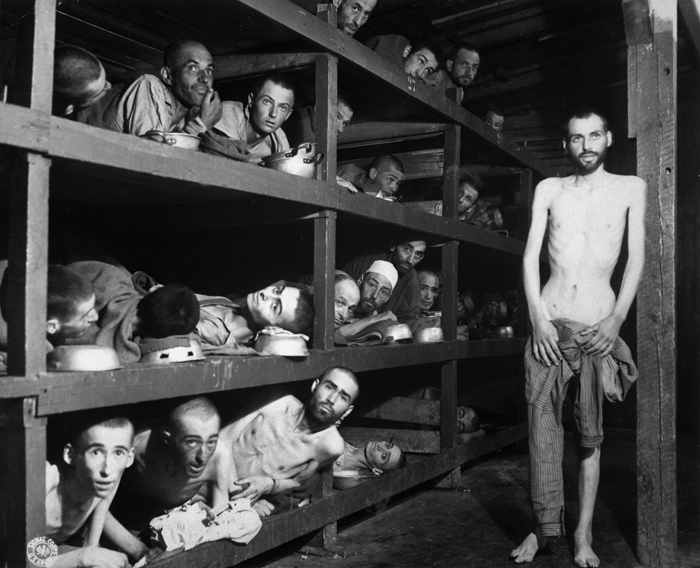
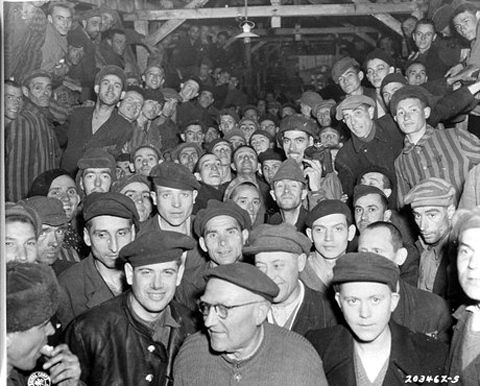
This famous photo of the Buchenwald survivors is said to have been first published in the New York Times on May 6, 1945 with the caption “Crowded Bunks in the Prison Camp at Buchenwald”. We were always told it looked like this:
However, the actual picture in the May 6, 1945 New York Times looked like this:
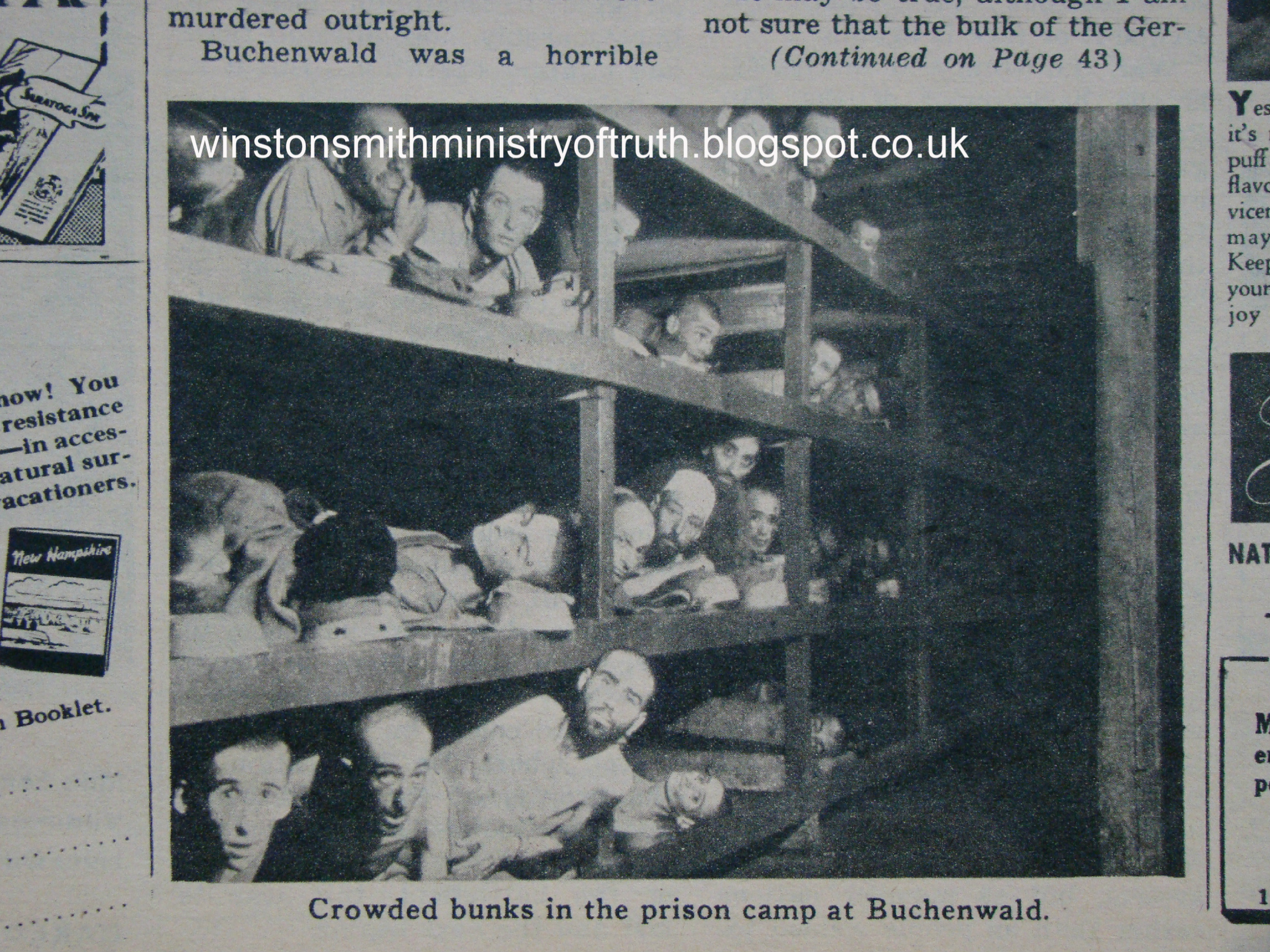
Where is the standing man? Not there. I have written about this here.
Things to notice: Besides the missing standing man, we can also see in the above picture that the last two vertical posts are missing the part below the bottom horizontal sleeping shelf. In other words, the “feet” of the posts, the part that touches the floor, are not there. (This has been noticed and remarked on by Eric Hunt) It begins with the post that is at the end of where figures are seen in the bunks. The standing man covered up this anomaly – without him, the rest of the bunks receding further into the distance are seen to be completely empty. These are just some of the questions surrounding this piece of propaganda.
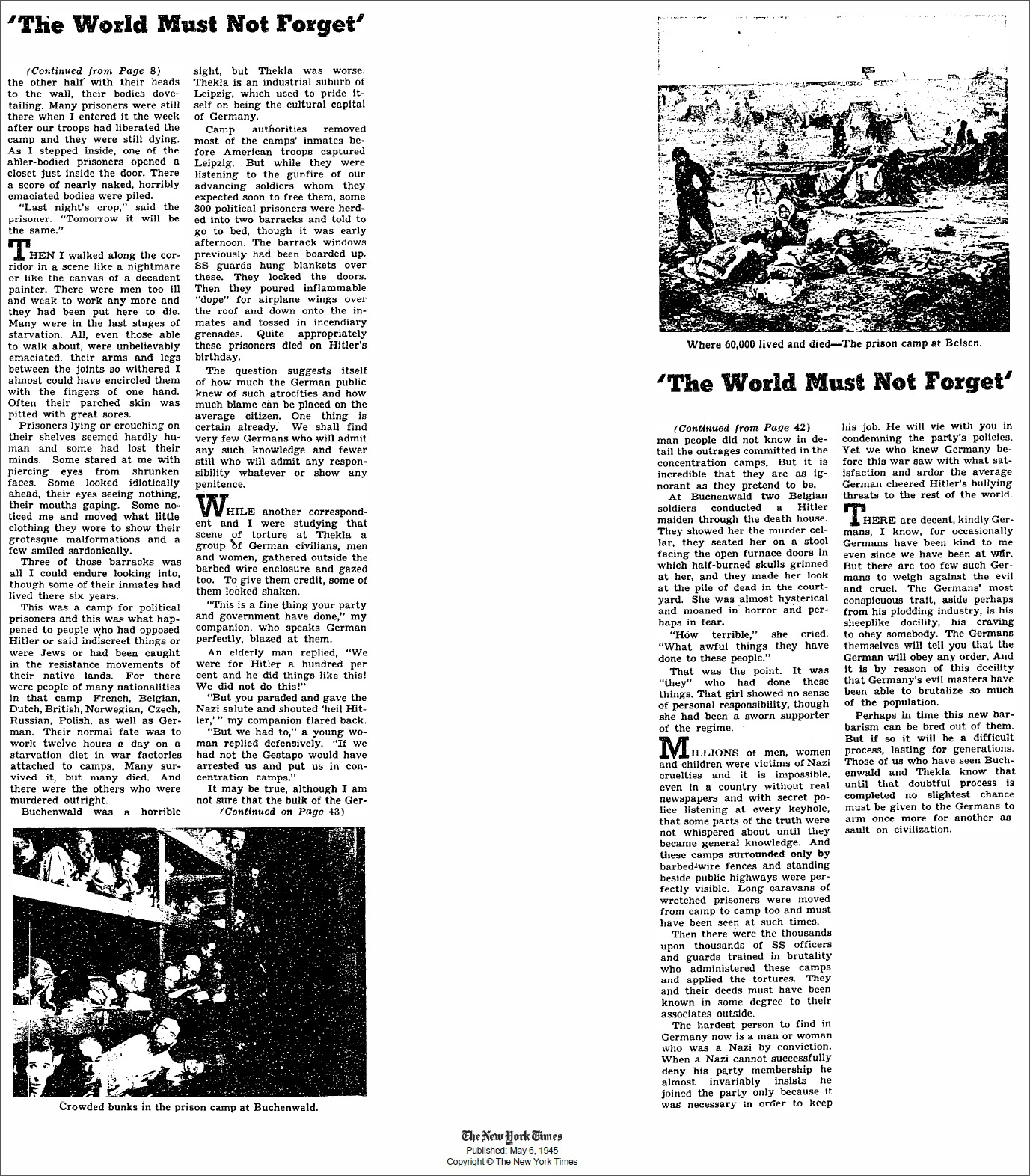
The entire page looked like this:
The photograph is said to have been taken inside Block #56 by Private H. Miller of the Civil Affairs Branch of the U.S. Army Signal Corps on April 16, 1945, five days after the Buchenwald camp was liberated (1) by a division of the US Third Army on April 11, 1945. None of the men were identified at that time. It was supposed to represent a typical chance encounter by the photographer in the liberated camp.
However, I have discovered and written about other serious anomalies in this photograph here, here, here and here, indicating that it is anything but a casual encounter with men in a barracks as it appeared in the final version of this photo. It is a major propaganda effort, a composite-photo of yet unknown extent of tampering, but it’s clear that figures have been added into the bunks that were not originally there and many people are misidentified.
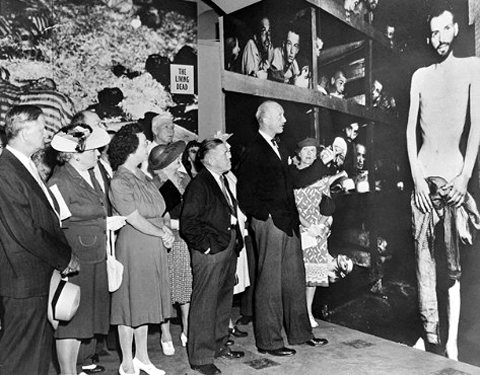
Above, you see a traveling exhibit of huge, larger than life size photographs from the National Socialist camps, including Buchenwald, being shown in St. Louis, MO in summer 1945; it was then taken to Washington, DC. The names of the liberated prisoners in the picture were still unknown, with no one asking to know who they were.
NOTE: It’s important to realize that all supposedly known persons in this photo are self-identified, except for the standing man.
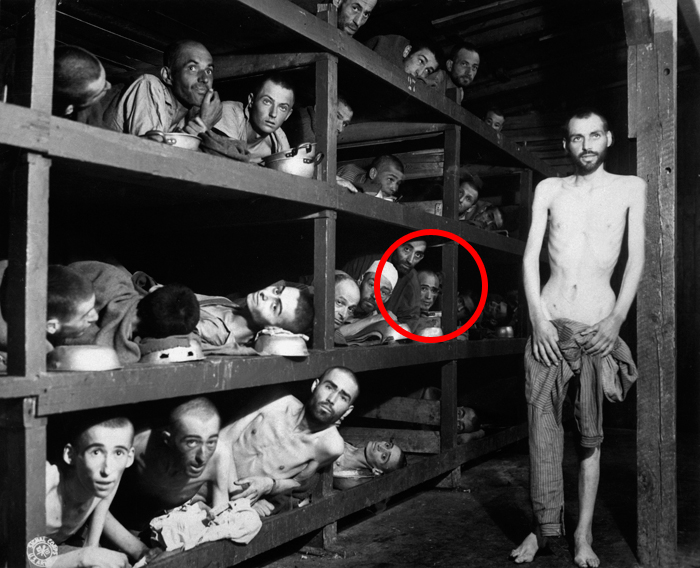
Elie Wiesel identifies himself, leading others to do so
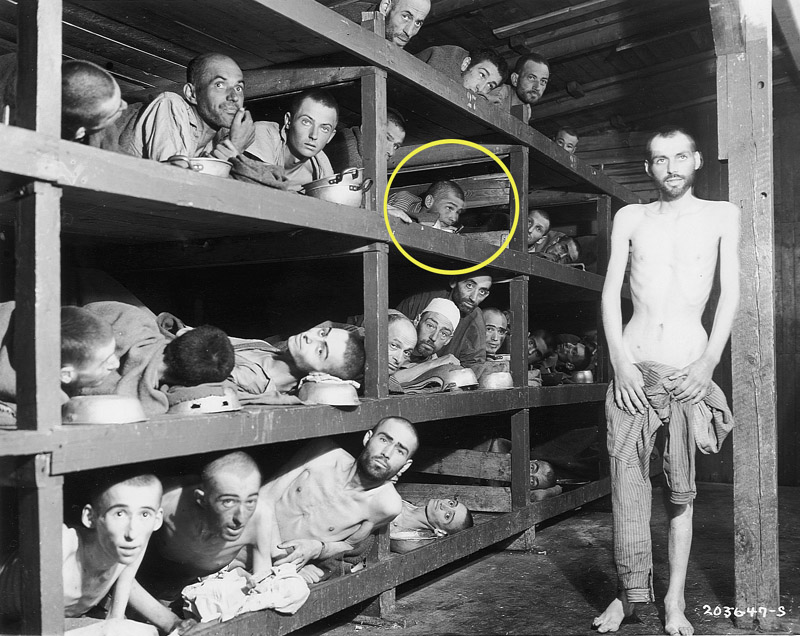
At some later date (we don’t know exactly when), Elie Wiesel, who was 16 years old on April 16, 1945, said that he was the face shown inside the red circle.(2) In October 1983 (when the campaign to get Wiesel a Nobel Prize began) this picture was published in the same high circulation Sunday New York Times Magazine in an article titled “Bearing Witness: The Life and Work of Elie Wiesel,” with this caption:
“On April 11, 1945, American troops liberated the concentration camp’s survivors, including Elie, who later identified himself as the man circled in the photo.”(3)
The exact “later” time has never been pinned down. Once Elie Wiesel identified himself in the famous picture, however, other decided they were in it too. Mel Mermelstein recalled how the picture was taken (4) in his book By Bread Alone, his biographical account of a legal battle with the Institute for Historical Review. He claims to be the face with eyes-only showing in the far upper right corner.
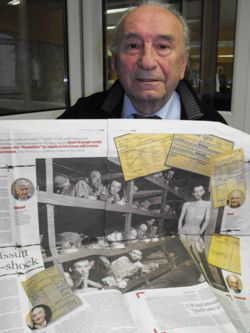
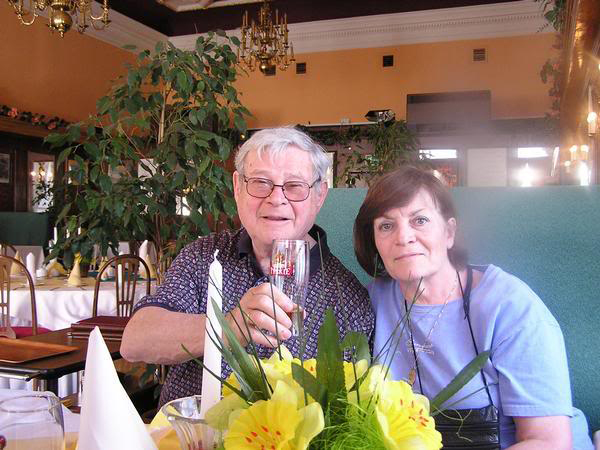
Miklos/Nikolaus Grüner has identified himself as the 16-year-old prisoner in the lower left corner. He is the only one who actually looks his age in that picture and he also resembles the man he is today, as seen here in 2009 holding a Swedish newspaper.
According to Scrapbookpages , an October 2008 news article published on the Sun Times news Group website , since removed, reported that Paul Argiewicz identified himself as the man whose face is shown in the circle in the photo below. He stated he was was not quite 15 years old when the photo was taken and had been in Nazi concentrations camps for 5 years!
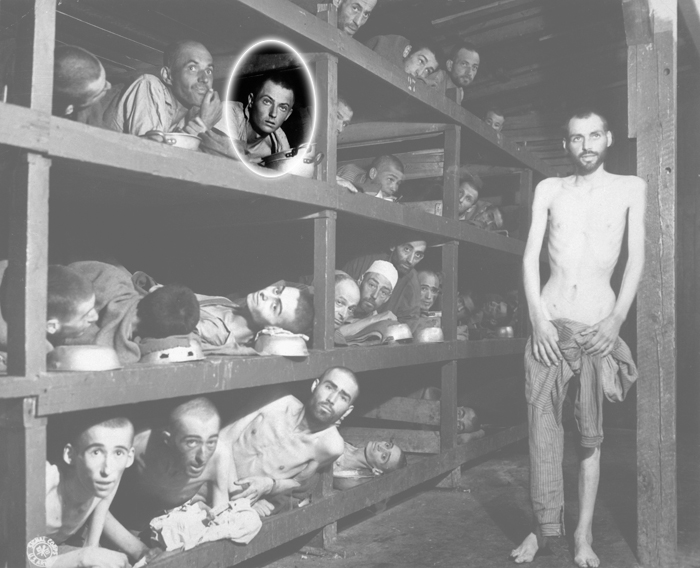
Argiewicz says he lied about his age during the “selection for the gas chamber” at Birkenau, claiming that he was 18 years old and was experienced as an electrician so that he would be selected for work, when he was actually only 11 years old and believed he would have been sent to the “gas chamber.” Argiewicz says he could speak fluent German because his mother was from Bavaria. (How could an 11-year-old pass for 18?)
The photo below shows Pawel Argiewicz as he looked in 1946 when his picture was taken for a German driver’s license. He is obviously not the same man as the older one in the famous photo.
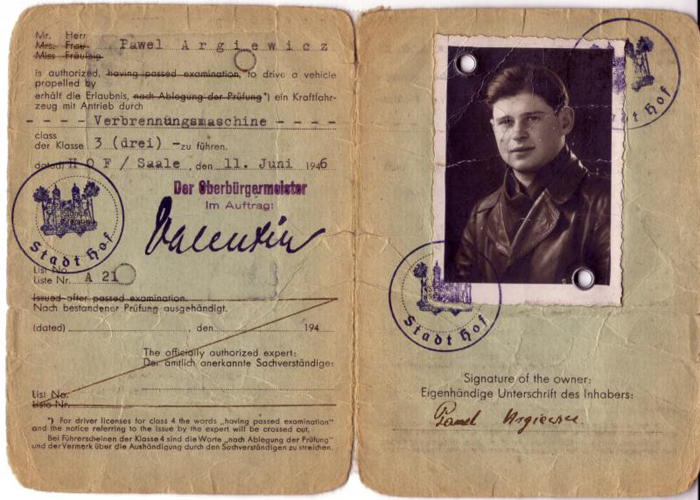
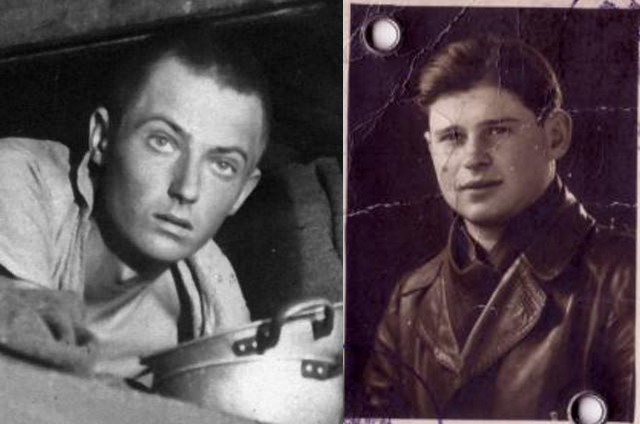
The two faces compared side by side.
Below is Paul Argiewicz in a photo taken March 2009. There is a clear resemblance between him and the face in the driver’s license photo. However, the man in these two photos looks nothing like the man in the photo taken in Block #56 at Buchenwald. Conclusion: Argiewicz is not in the famous photo. Too bad, Pawel, but you’re outed.
Other prisoners mis-identified
Other former prisoners who have been identified can be seen here. Simon Toncman (standing), Helman Leefsma, and Max Hamburger were all from The Netherlands, and had been sent to Buchenwald after they had been captured while working with the Dutch resistance. Strangely (compared to the others who claim to be in this photo), Simon Toncman never talked about being in this picture, according to the photo caption on Flickr – maybe because he wasn’t!
The other two are falsely identified. Leefsma is said to be born in 1924, which makes him 21 years old in 1945. But we can see that he is balding and clearly an older man, possibly even in his 40’s. Max Hamburger is self-identified, but the figure he says is himself is a poorly disguised version of the man 3rd from the left in the 2nd row. I have clearly demonstrated this here and here. Hamburger does not claim to be the man in the 2nd row, but specifically the one in the bottom row.
 Naftali Furst, also self-identified as the man circled at left, who is 5th from the left in the 3rd row, is not in this picture either, in spite of the fact he was in the children’s barracks in Buchenwald and was photographed at liberation. He has been exposed here.
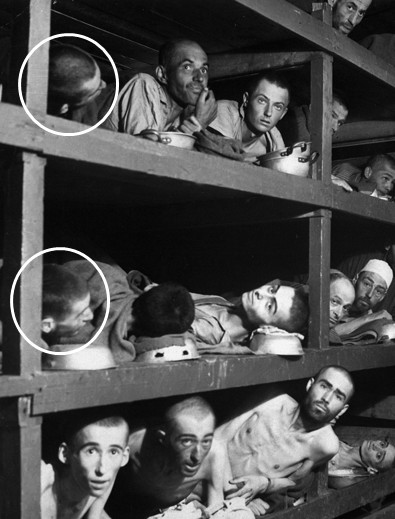 Same man?
I’m also questioning whether the two heads circled in the picture at right, who are on the far left in rows two and three, are the same person. They strike me as so similar that I wonder if two shots of the same guy were added to the photo later to make the “crowded bunks” look more crowded? Why would they both be looking to the right instead of at the photographer, as the others were? What would cause them both to hide their face? The sleeping man in the second row could be the same guy.
This famous photograph was most likely elaborately staged and then “added to” as thought necessary. In any case, it is anything but a casual encounter by a liberator-photographer of the actual conditions in the camp on April 16, 1945. It is continuing war propaganda.
The orphans of Buchenwald
We look now at a photo taken on April 27, 1945—eleven days after the famous photo was taken—of Buchenwald orphans marching out of the camp with their caretakers to new lodgings in the former SS barracks. The youths and children in Buchenwald (why were they even there rather than eliminated?) had been housed in Barracks #66 in the Buchenwald “Small Camp.” Barracks #56 (for adults) was also in the “Small Camp”, which was a special quarantine section for prisoners, mostly Jews, who had recently arrived from other camps, such as Auschwitz-Birkenau.
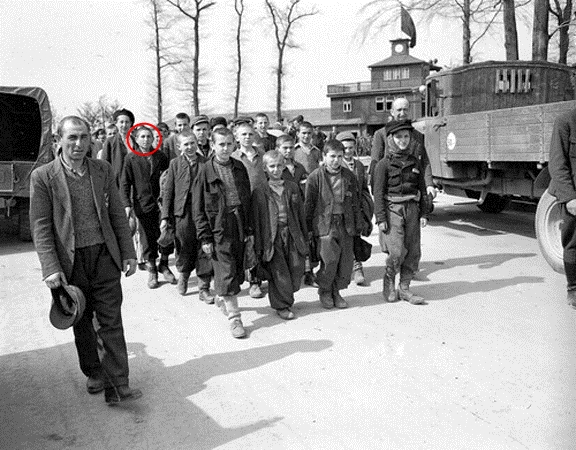
In the photo above, the boy in front of the tall boy in the left column of boys, third from the front, (circled in red) has been identified as Elie Wiesel by Prof. Kenneth Waltzer on his Michigan State University website (now taken down). Waltzer teaches German History and directs the Jewish Studies Program at MSU. He has been writing a book for the past 6 years about the orphan boys at Buchenwald. Do the faces below, both purporting to be Elie Wiesel, look like the same person, 11 days apart? No way. Plus, could the man in the barracks be a 16-year old?
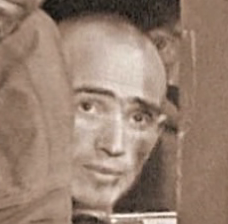
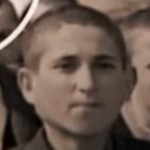
Above: man in Buchenwald barracks #56, April 16 — compared to boy in marching group, April 27.
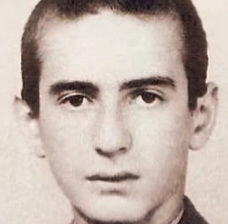 At left is a picture of Elie Wiesel at age 15, taken before his deportation. Neither of the other two pictures above claiming to be of Elie Wiesel resemble this one at all. Check the shape of the mouth and the height of the forehead. The man in the barracks also has a receding hairline.
In addition to all these problems, Elie wrote in his book Night (and also in his 1995 memoir All Rivers Run to the Sea) that he became sick with food poisoning three days after the Buchenwald camp was liberated on April 11, 1945 and was in the hospital for two weeks. That means that it’s highly unlikely he could be in the photo of the orphans above, only one day after leaving the hospital. And he absolutely could not be in the photo of Block 56 at the top of this page, taken on April 16, unless he’s lying about being in the hospital.
In the book “The Children of Buchenwald” by Judith Hemmendinger and Robert Krell, there are the stories of 31 of the 904 orphan boys at Buchenwald, including the story of Elie Wiesel in Chapter 11. On page 113 of this book, it is mentioned that Block 66 was the barrack for the orphan boys at Buchenwald.
Jewish professor Ken Waltzer wrote, regarding the orphans at Buchenwald: “Among the older boys was Eliezer Wiesel from Sighet, Rumania, who was protected in block 66 with hundreds of others.” Waltzer also wrote in Harper’s Magazine, Dec. 31, 2008, that “Margaret Bourke White photographed [the 904 orphan boys] as did hundreds of visiting American soldiers.” Why, then, do we not see more photographs of these boys in the camp, and especially Elie Wiesel among them? Or anyone who resembles Elie Wiesel?
Miklos Grüner and Elie Wiesel were both orphans (although there is no record of Elie’s father at either Auschwitz or Buchenwald) who should have been in Block 66, the orphan’s barracks, so how did they get in a photo taken in the adult barrack, Block 56? (5)
Grüner, even though his father died at Auschwitz leaving him orphaned (6), was not sent to France with the others, but to a clinic in Switzerland because he was found to be suffering from tuberculosis. Some of the inmates in the famous photo appear to be sick, while others look healthy and of normal weight.
This suggests strongly that the photo was staged. As already mentioned, this picture was not taken on the day of liberation, but 5 days later. The photographers were setting up pictures that complemented the propaganda that was being prepared for the world. Possibly some sick prisoners were brought in to Barracks 56 to give the appearance that the general population of the camp was starving.
Below is another Buchenwald liberation photo taken on April 14, 1945, two days before the famous photo.
It shows a barrack full of Buchenwald survivors who appear to be in very good health and are warmly dressed, too. They are fully dressed while in the famous photo the sick men are shirtless to expose their bony frames. The photographer has packed the men above into this barracks to give an impression of overcrowding. Or maybe just to get as many in one picture as possible for souvenir purposes? At any rate, this is a strange comparison with Barrack 56.
Summing up
It is clear from this analysis that
A. Elie Wiesel has lied about being in this photograph.
B. Several others have also lied about being in this photograph.
C. Authorities and ‘historians’ have accepted the identity of many of the persons in this photo without any investigation – simply on someone’s say-so.
D. Only two people resemble who they say they are and that is Nikolaus Grüner (lower left) and Mel Mermelstein (upper right).
E. There are so many anomalies and unanswered questions about this photo that it must be considered 100% post-war United States “Holocaust” propaganda ordered by Eisenhower’s U.S. Army intelligence branch.
F. This photo show the level of skill in photo-manipulation that existed in 1945.
Footnotes:
- Actually, it was ready and waiting to be turned over to the United States military authorities whenever they arrived.
- The highly regarded British ‘historian’ Martin Gilbert doesn’t mention Wiesel or Mermelstein as being in the picture in The Macmillan Atlas of the Holocaust, published by him in 1982. He writes of it, “The photograph, taken on the day of the liberation of Dachau, shows some of the survivors of death marches and evacuation trains …” :-)
- Samuel G. Freedman, “Bearing Witness: The Life and Work of Elie Wiesel,” NYT, October 23, 1983.
- The July 26, 1985 Billings Gazette published an Associated Press photo showing Mermelstein holding the famous photo with the caption: “Mermelstein poses with a photograph showing himself on a bunk in the Auschwitz concentration camp.”
- In his book Stolen Identity, Grüner gives an questionable explanation on page 28. He writes that as the inmates of Block 66 were being marched toward the gate (before liberation), he faked an emergency need to relieve himself and ran to the first barrack he could reach, which turned out to be #56. There he laid down in a bunk where he remained. No way to verify this, but Elie Wiesel gives no explanation at all for why he was there. Of course, since he says he was gravely ill in the hospital at the time this picture was taken, he could not be in two places at once.
- He had an older brother and a sister who survived the camps, with whom he was put in contact after liberation. Both moved to Malmo , Sweden . (Stolen Identity, p. 29.)

