Archive for the ‘Featured’ Category
Saturday, October 2nd, 2021
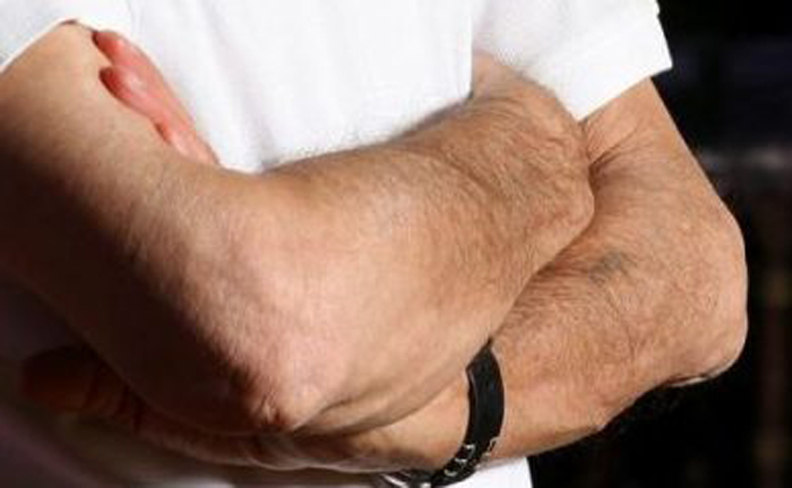
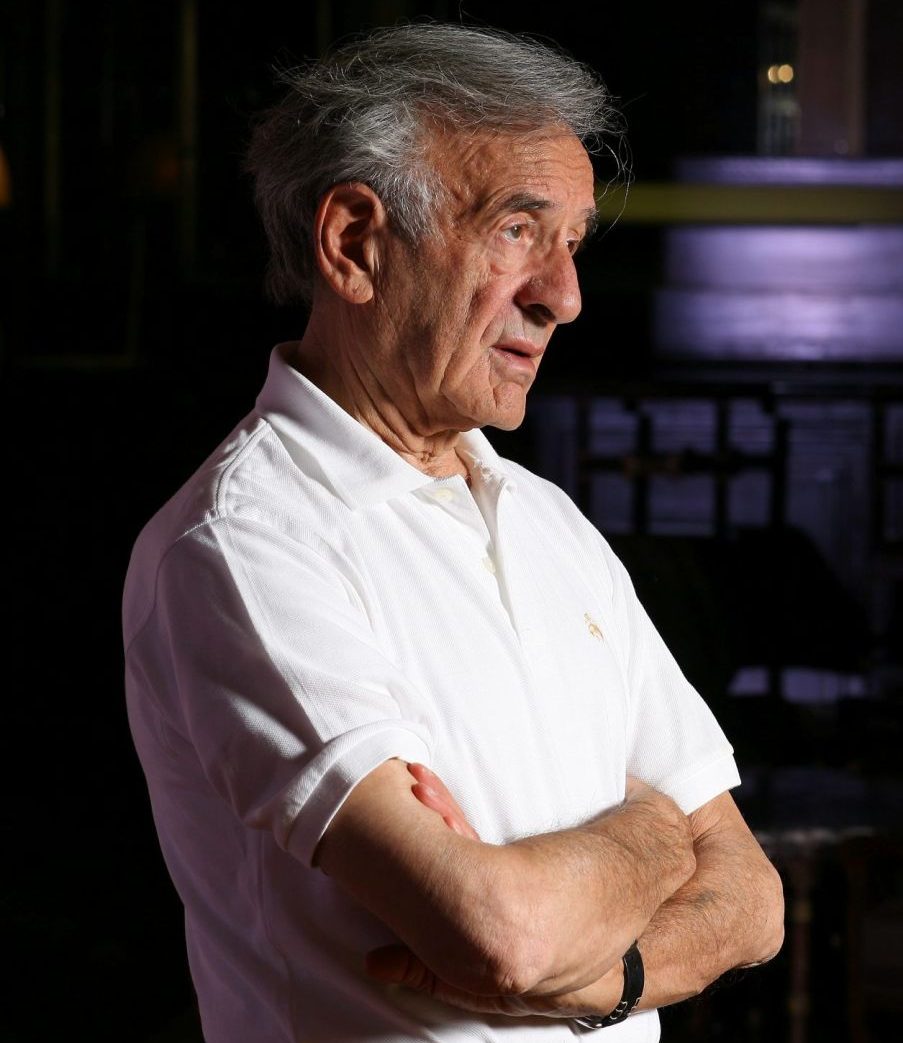
Close-up of Wiesel’s arms from the photograph taken in 2006 by Eyal Toueg, published after Elie Wiesel’s death.
By Carolyn Yeager
It’s been five years now since Elie Wiesel died and his body was buried in a plain pine coffin.
This website premiered in July 2010 with the question: “Where’s the tattoo?” No one had ever seen it, yet Wiesel claimed to have it as proof he was an inmate at Auschwitz in 1944. Please refer to “Where is Elie’s tattoo?” before you read further.
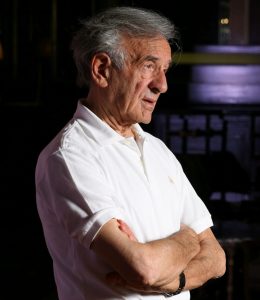
The full image as published in Haaretz a week after Wiesel’s death in July 2016.
In seven years, this site had learned and published a great deal [over 130 articles] about Elie Wiesel’s life events and the incredible trail of lies he left in his wake. But we had still not seen the tattoo! That is, until the above photo was published by Haaretz, a leading Israeli newspaper, a week after his death. Behold! the distinctive appearance of a bluish smudge on ElieWiesel’s bare left forearm. The photo, said to be taken in Israel in 2006 by Eyal Toueg, is high-resolution and gives every appearance of being an authentic representation of Wiesel at that time—in other words, not photo-shopped. Haaretz is a generally reliable source with a reputation to protect. Since then, I’ve seen no further mention of the photograph.
My takeaway on what we see there is that it is clearly NOT the number A-7713, which is what Wiesel claimed all his adult life he had. He lied—and got away with it. Please see my articles “How Wiesel’s ‘tattoo’ looks from where I’m sitting” and “New (old) pictures come to light in wake of Elie Wiesel’s death” for my impressions in 2016.
Five years later I can say with confidence that whatever it was that may have been on his arm and appears to have possibly been removed was never the number A-7713. (Why? Because it it were A-7713, it would not have been removed while he was still claiming it was there.)
“Appears to have been” is the key here because we’re dealing solely with appearances. We have no statements from Wiesel’s intimates and allies about the tattoo. When it comes to questions about that, they are mute. We also have other images of Wiesel’s bare arm with nothing appearing there or with what could be a faint trace of a number (see below). However, no matter how much these “faint traces” are enlarged, no number can be made out—it is seen to be only a ‘shadow’ on the arm.
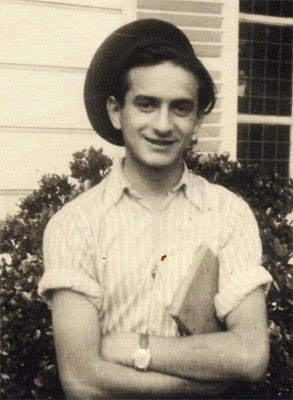
Elie Wiesel in Ambloy, France in 1945 with mark on arm that disappears into nothing when enlarged.
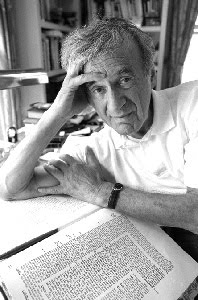
This photo taken on the same day as the one above in 2006. Wiesel is wearing the same shirt and his wristwatch is facing down. But the faint mark on his arm doesn’t match the image above.
The explanation for these last two photos, one taken in 1945 and the other on the same day in 2006 he was wearing the white knit shirt, is that they were both uploaded to the Internet by Loupi Smith and no one else! Neither of these images are found in the U.S. Holocaust Memorial Museum collection, the Auschwitz-Birkenau Museum, or even at Yad Vashem. If they were proof that Elie had a tattoo, wouldn’t they be there?
Loupi Smith is a notorious French Jew who’s long been engaged in battle with revisionists (known as negationists in France), most especially with the honorable Vincent Reynouard. It’s most likely that Smith took images of Wiesel without any mark on the arm and applied the desired effect directly to the photographic print he had obtained. He then uploaded these to the Internet and waited for them to be found, or had friends/agents who “found” them.
As to why Haaretz decided to publish this photo right after Wiesel’s death, Haaretz will have to answer that. We are not mind-readers and have to depend largely on honesty from the parties involved, but honesty has never been forthcoming from Holocaust advocates. For example, see my articles about AP reporter Verena Dobnik who in Nov. 2012 wrote that Wiesel showed her his Auschwitz tattoo by “pulling back his left jacket sleeve” during an interview she was conducting with him. Of course, she didn’t and never would say what it was, just that it was an “Auschwitz tattoo.” See “AP reporter doesn’t reply to questions about seeing tattoo on Elie Wiesel’s arm” and “AP stonewalling legitimate questions about reporter seeing Elie Wiesel’s tattoo.” Nothing unusual here, though—it’s the usual behavior from all media and government sources when it comes to anything “holocaust.”
FINAL CONCLUSION: Elie Wiesel lied about his tattoo. All the feeble explanations/excuses put forward by his supporters and fans for why he refused to show it are inadequate in the face of the proofs we’ve assembled. Wiesel stole the identity of Lazar Wiesel, who was 13 years his senior and who was recorded as being an inmate at Auschwitz-Birkenau (tattooed with A-7713) and at Buchenwald camps in 1944-45. No records for a 16 or 17 year old Eliezer Wiesel born in 1928 exist at either camp.
If he lied about the tattoo, it is certainly believable he lied about being in Auschwitz and Buchenwald. In support of that possibility are the facts that his stories and descriptions don’t match the well-known reality of the camps; his timelines are off; people who were known to be there at the same time he was, even housed in the same buildings, never mentioned seeing him—either before or after he became famous. All this and more is documented at this site.
Elie Wiesel’s “Idea”
Equally important to Elie’s lack of the claimed tattoo is, in my opinion, his admitted twisting of what it means to be a witness. There are two parts to his approach: 1) What happened may not be “true” and what is the “truth” may not have actually happened, and 2) Every Jew should be a witness to the Holocaust regardless of whether they actually participated. Part 2 is made possible by part 1.
Wiesel announced his willingness to deceive in several of his books, and in interviews. Even though he told us exactly what he was doing, it seems no one wanted to take it seriously. The sainthood of Elie Wiesel was too appealing.
 Of his several statements, covered in my article “Elie admits his true stories never happened,” I think the most compelling was in a 1970 interview with Gilles Laponge, published in the book Elie Wiesel: Conversations (2002). You can find the interview online HERE at Google Books. Wiesel said:
In [my] book “One Generation After” there is a sentence which perhaps explains my idea: “Certain events happen, but they are not true. Others, on the other hand, are, but they never happen.” So! I undergo certain events and, starting from my experience, I describe incidents which may or may not have happened, but which are true. I do believe that it is very important that there be witnesses always and everywhere.
[…]
The people of my generation are, in various ways, all survivors. We must prevent the Holocaust from being erased from the memory of the world.
He’s telling us he’s writing fiction “based on his experience” but insisting it’s ‘true’, and even 100% true. What is the basis of his experience? Being a Jew. A Zionist Jew. Wiesel’s life history of being a Hasidic Jew is primary in his experience, according to his own words. This means he accepts the following and has said so:
- Belief taking precedence over Reality;
- Religion over History;
- Storytelling over fact-finding;
- Hearsay over first-person evidence; and
- Feelings over Justice.
In other words, it’s Ashkenazi Jewish mysticism vs European Christian Law. It’s interesting to note that at Boston University, where Wiesel had a cushy “professorship” for many years, he taught in the Religion and Philosophy Departments, not the History Department. See my article on BU here.
A little further in the interview Wiesel continues with the cloudy language:
“I believe in a way we are all culpable even though the guilt of the torturer is not that of the witness or the survivor. Do not see in my words the least resignation to evil. […] No, evil is absurd the same way the Holocaust is absurd. I remain convinced that this event, the most significant in history, might very well not have happened.”
Everyone can be a survivor, with the important job of preventing the memory of the Holocaust from being lost or “erased.” For this purpose, apparently everything and anything goes. Making things up to be far worse than they actually were is nothing unusual. It’s considered necessary to reinforce the memory.
When Wiesel claims that “every word” in Night “is true,” he’s using a definition of “truth” different from the standard dictionary meaning. When testifying in a court of law, the lawyers and judges should first establish what is his understanding of truth, but they never have.
On this basis, Wiesel received award after award from prestigious Gentile groups, all the way up to the Nobel Peace Prize. Wiesel has indeed conned the world.
We pronounce Elie Wiesel a false witness from beginning to end.
2 Comments
Category Featured | Tags: Tags: Auschwitz tattoos, Elie Wiesel, false witness, Holocaust fraud,
Social Networks: Facebook, Twitter, Google Bookmarks, del.icio.us, StumbleUpon, Digg, Reddit, Posterous.
Thursday, October 10th, 2019
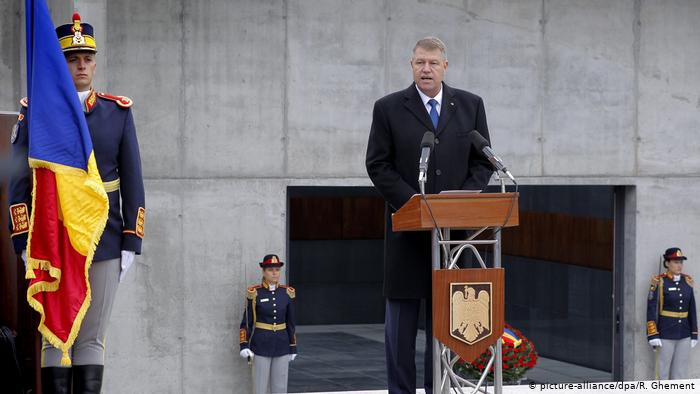
Romanian President Klaus Iohannis announced on Tuesday in Bucharest his approval for the creation of an official Romanian Holocaust Center under the auspices of the Elie Wiesel Institute for Study of the Holocaust.
By Carolyn Yeager
President Klaus Iohannis announced on Tuesday (Oct. 8) his official approval for the creation of the country’s first Holocaust museum in Bucharest, Romania’s capital. He said in a ceremony attended by ‘holocaust survivors’:
“The history of Jewish Romanians, their contribution to the country’s development and the tragedy experienced during the war… represent a legacy which was hidden from us for decades.”
He added: “This museum will not so much bring answers as raise more questions.” He said the goal was to recover the memory of the Holocaust [or maybe to invent it where necessary?]; strengthen the education about the Holocaust, and combat anti-Semitism [oh yes, that too – the actual main goal]. The museum will take up space in a WWII era eight-story building in central Bucharest.
Elie Wiesel behind the museum plan
The new museum will be coordinated by the Elie Wiesel Institute for the Study of the Holocaust in Romania, a “think tank” created by Wiesel and his handlers in 2005. Wiesel claims to have been born in Sighet, Hungary in 1928, which is now part of Romania. In 2004 an international panel led by Elie Wiesel estimated that between 280,000 and 380,000 Romanian and Ukrainian Jews perished from territories under Romanian administration from a total of 750,000. It also found 11,000 Roma were killed. For reliability of Elie Wiesel Institute facts and figures, see “Elie Wiesel Institute Wrong on Romanian Grave Claims.” Also, previous story here.
Elie Wiesel died in 2016.
Only 3,200 (admitted) Jews still live in Romania, according to the last census in 2011; other sources say 8,000 to 10,000. [Jews moved to New York where the living is better. Thousands of others changed their identity to Christian and remain in Romania officially undetected.]
Romania switched sides in the world war in 1944. The government was originally strongly allied with the victorious Germany, but when the tide turned, the Romanian army deserted and opportunistically, with all their German weapons and gear, went over to the Allies. Romania was therefore under Soviet communist control for the next 45 years, remaining a backward, dreary and corrupt country. That was in large part what drove so many Jews to leave. They want communism for Gentiles, but not for themselves.
Tuesday, October 24th, 2017
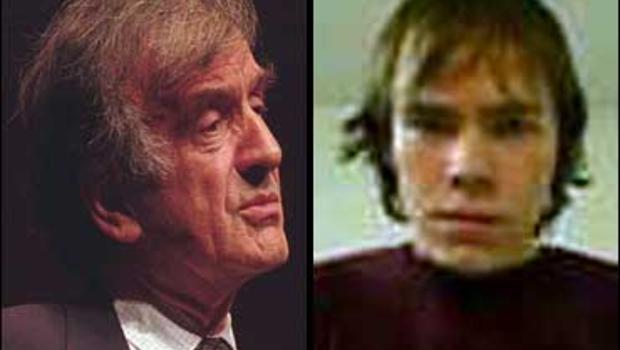
Elie Wiesel (left) at the trial of Eric Hunt (right) was quite prepared to put the 22-year old away for life for frightening him by taking hold of his arm in an empty hotel hallway in 2007. Is it surprising that someone who’s been through the “worst there is” should still be so frightened of a kid?
Which is worse: Grabbing a man’s arm or grabbing a woman’s ass?
By Carolyn Yeager
Attack ‘victim’ Elie Wiesel attacks 19 year old girl and runs away
Elie Wiesel has been accused by a Jewish mother of four, married, a Ph.D from New York University of having squeezed her buttock when she was a vulnerable 19-year-old attending a Jewish charity dinner with her boyfriend’s family. Wiesel, of course, died last year and it’s doubtful his family will comment on the charge.
What it brings to mind for me is this: Elie Wiesel fully cooperated in the prosecution of a 22 year old male, the at-the-time completely unknown Eric Hunt, for grabbing his arm in a hotel elevator in 2007. And now it comes out that Wiesel is also a perpetrator: guilty of surreptitiously grabbing a young woman’s buttocks at a Jewish charity dinner in 1989.
In 1989, Wiesel was 61 years old and it had been only three years since he won the Nobel Prize for Peace in Oslo. He was at the height of his fame.
I believed Jenny Listman’s story right away because radio personality Deanna Spingola had told me of her experience meeting Elie Wiesel after a speech he gave as a “Holocaust survivor.” I do not recall where or when this took place, but Deanna claims she went up, along with other audience members, to meet the famous survivor after his speech. As I remember her telling it, he fixed his gaze on her with suddenly aroused interest, and whatever physical contact took place, whether handshake or something more, he held on to her longer than she felt was appropriate. He also engaged in chatty conversation, asking her about herself. Deanna, at the time an attractive single working woman, blonde and blue eyed, felt the unmistakable sexual vibes emanating from Mr. Wiesel toward her. I suppose if she had told him where she would be after the event (in the hotel bar for instance) he would have found a way to show up there. The impression Deanna had then, at a time she was still a believer in the holocaust narrative, never changed: that he’s a womanizer.
I never doubted Deanna’s account; I hope she will come forward and describe this experience in her own words, for the record. I am not the only person she told this to.
Now, hearing Jenny Listman’s story is confirmation for me that Wiesel was just another run-of-the-mill sexual predator from New York City, a breeding ground of such types.
Listman, describing herself as a non-observant Jew, writes about what happened to her in exquisite detail on her own blog page dated Oct. 19, 2017, as part of the #metoo Twitter campaign following the accusations against Hollywood producer Harvey Weinstein. She defines herself as a PhD, married mother of 4, New Yorker; data science, data visualization specialist. She begins her long post with a quote from Elie Wiesel’s Nobel Peace Prize acceptance speech in 1986:
“I swore never to be silent whenever and wherever human beings endure suffering and humiliation. We must always take sides. Neutrality helps the oppressor, never the victim. Silence encourages the tormentor, never the tormented.”
Listman explains the event as follows: She was participating in a group photo of her boyfriend’s family with guest speaker Elie Wiesel following a dinner given by the Jewish charity to honor their deceased father and husband. Wiesel suddenly said “Wait,” untangled himself from his place in the center of the group, darted in between Listman and her boyfriend at the far end, and then said, “Ok” to the photographer. Listman felt his hand on her shoulder inch down her back until, at the moment the photographer snapped the picture, Wiesel’s hand “squeezed her right ass cheek” and Wiesel “RAN, disappearing into the crowd of over 1000 people.”
When she told her boyfriend what had just happened, he responded with disbelief. Maybe she was mistaken, he suggested, or imagined it. No, she said, she was sure. But she didn’t push the matter any further. She knew it would just upset everyone. And so did Elie Wiesel know that.
The boyfriend, whom she later married and divorced, confirmed this conversation took place, according to Linley Sanders at Newsweek.
Remember that Wiesel’s speaking fee was $25,000 plus chauffeur-driven limousine to and from. Per talk. He was probably not friends of the man being honored, or his family, but was hired by the charity. (That is where so much of your charity money goes – something to keep in mind.) This explains why he was looking to entertain himself while doing a boring job for pay.
Reaction to this revelation
Reaction from the Jews is to downplay, disbelieve or deny. Non-Jews are staying away from the whole story – too hot to handle. They might say the wrong thing and never recover from it.
Commentary, a Jewish publication ran a dismissive article by Daniella Greenbaum the next day, Oct. 20, in which Greenbaum said she didn’t believe Listman’s account, and made her out to be mentally unstable.
The Forward Jewish news organization ran Listman’s accusations when they appeared, but then published a sort of apology/retraction two days later, saying the story “did not meet our journalistic standards and has been removed.”
The far-left Salon website posted the story, concluding that (in my words) there are not just ‘holocaust survivors,’ but there are ‘sex abuse survivors’ too, and we must listen to all of them and sort it out as best we can.
The best coverage of all is what you find right here on Elie Wiesel Cons The World.
Elie Wiesel condemns others but cannot admit his own human failings
To return to Wiesel and Eric Hunt, I think it is the most important moral of the story. Wiesel for many, many years accepted being portrayed as a paragon of blameless virtue and, in turn, portrayed all “holocaust survivors” as blameless victims of totally evil Germans. He was a proponent of the Jewish idea of “Never Forgive, Never Forget” and his infamous sentiment, “Every Jew must set aside in his heart a special place of hate for the German and what the German represents.”
When young Eric Hunt tugged on his arm in a San Francisco hotel demanding to speak to him privately, then let go, turned and walked away when Wiesel began yelling for help, Wiesel called the police and was okay with having Hunt charged with attempted kidnapping, false imprisonment, elder abuse, stalking, battery and the commission of a hate crime – which would have confined the youth to prison for possibly the rest of his life. Wiesel said he was very frightened, which was clearly an unforgivable thing to do to him.
Wiesel then testified at Hunt’s trial, during which he lied under oath about his purported Auschwitz tattoo and his book Night–no big deal to the blithe and breezy icon who can ‘run away’ from his own unlawful actions. Luckily for Hunt, his age and prior clean record allowed the counts against him to be cut to misdemeanor battery and misdemeanor elder abuse to which he had to plead guilty in order to be let off with time served and probation. A Man of Compassion, Wiesel is not.
How will the Wiesel admirers react to their icon’s sexual abuse of a teenager? Will there be more “#metoo’s” showing up in the near future? I’m sure there are more, but whether they have the will or desire to speak out is uncertain, especially as the majority are probably Jewish. I believe the Jewish power structure will crack down hard on any and all disloyalists. But we will keep watching and reporting it if more develops in this fascinating and unexpected saga.
Sunday, June 11th, 2017
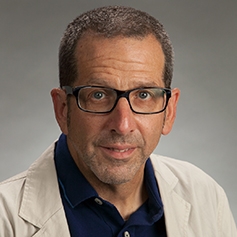
Alan Astro PhD, Trinity University
By Carolyn Yeager
I happened upon this video and recognized my own text of Yiddish-to-French-to-English translation being used by this professor at a Catholic university in San Antonio TX. Though a native of Brooklyn, Alan Astro says he has been at Trinity University for over 25 years. His field is modern languages and literatures; one of the subjects he teaches is Yiddish culture.
His lecture, titled “Christianity and the Holocaust in Elie Wiesel’s Night” was filmed by St. Francis College and at the 6min59sec mark, he shows text from my very important 2012 article “Night #1 and Night #2—What Changes were Made and Why, Part One.” So you never know who is reading this site – a lot of people and all people who have a professional interest in Elie Wiesel.
At 6:59, Astro shows text translated by Kladderadatsch for this web site, which he calls “Where’s the tatoo?” (sic). He says that even though Yiddish was not known very well even in the Jewish world … “Holocaust deniers somehow get their hands on the Yiddish and manage to get it translated. Here is one holocaust denier or minimizer on the web who makes a whole big deal about the fact that in the Yiddish and French and English original translations Wiesel “is not quite 15” when he is arrested and sent to Auschwitz, whereas he is 15 in the newest edition and this is considered to be something that somehow questions the veracity of the whole historical knowledge of the Holocaust. But that’s another issue all together. But it does show you that things can very often have strange consequences.” (He goes quickly to something else at 8:10. So Astro has my text on the screen for one minute, 11 seconds, enough time to read it all.
This is the segment he used:
3. Not yet fifteen … or fifteen?
UdV Page 63 : Yingl, vi alt bistu? fregt mir a heftling. Zeyn pnym iz geven in der fintster, ober zeyn kol iz geven a mids, a varems. Nokh nisht keyn 15 yor, hob ikh geentfert.
“Kid, how old are you?” a prisoner asked me. His face was in darkness, but his voice was tired and warm. “Not yet 15 years,” I answered.
LN Page 54: Hé, le gosse, quel âge as-tu? C’était un détenu qui m’interrogeait. Je ne voyais pas son visage, mais sa voix était lasse et chaude. “Pas encore quinze ans.” / Not yet 15 years.
SR Page 39: “Here, kid, how old are you?” It was one of the prisoners who asked me this. I could not see his face, but his voice was tense and weary. “I’m not quite fifteen yet.”
MW Page 30: “Hey, kid, how old are you?” The man interrogating me was an inmate. I could not see his face, but his voice was weary and warm. “Fifteen”
This very important passage was discussed above. I think the reader would agree that “not yet 15″ can mean even farther from the age of 15 than “not quite fifteen.” What is clear is that Marion Wiesel has changed the author’s original words to fit them to her husband’s age in Spring 1944.
Astro dismisses this important observation with the misrepresentation (in boldface above) that the example is intended to negate the entire holocaust story. No, it isn’t; obviously it questions the veracity of Elie Wiesel’s truthfulness in “Night” since this scene took place in April or May, and the real Wiesel’s 16th birthday was coming up on September 28, 1944. Thus Wiesel was not 14 in Spring ’44, but had already been 15 for at least 7 months. Astro is not interested in telling that to his audience or pursuing it himself. He is a professor of languages and literature, but not an expert on Elie Wiesel or the Holocaust. Far, far from it.
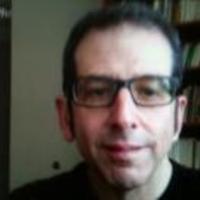
Another photo of Professor Alan Astro.
At 19:33, hear him pronounce Wiesel’s name as weasel (as I say it) and then quickly correct himself to the affectation Wie-zell that he used throughout the talk. This indicates that ‘weasel’ is his default way of pronouncing the name, or the way he first learned it.
At right is another photo of Professor Astro I found online that gives what might be a truer look at the man.
8 Comments
Category Featured | Tags: Tags: Elie Wiesel, Naomi Siedman, Night, Un di Velt Hot Gesvign,
Social Networks: Facebook, Twitter, Google Bookmarks, del.icio.us, StumbleUpon, Digg, Reddit, Posterous.
Friday, June 9th, 2017
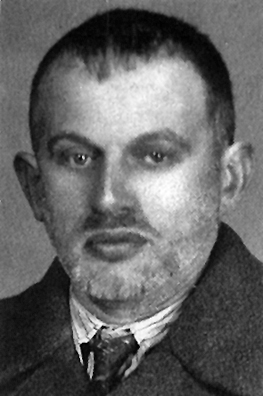
Shlomo Wiesel, Elie’s father, in 1942, a young looking man.
By Carolyn Yeager
Elie Wiesel wrote two ‘official’ accounts of his 1944-45 concentration camp experience: his novel Night (1958) and his official autobiography (Part One), All Rivers Run to the Sea (1995). Thirty-seven years separate these two publications.
Three articles written by me in 2011 (and here) and 2012 contain information that demonstrate conclusively that Night is not a true account of the experience Wiesel may have had with his family at Auschwitz-Birkenau in 1944. Night is written for “effect” and to be a gripping father-son drama that rises to the standards of a literary work of art. Night cannot, therefore, be called Wiesel’s testimony – a claim he made on several occasions.
Because a lot of information was conveyed in these three articles – a lot of details were covered, and I had other purposes in mind – this crucial fact easily gets lost to the reader’s attention. In this article I will zero in on this “crucial evidence” in order to make it crystal clear why Night can only be considered a work of fiction and Elie’s autobiography “All Rivers …” is the place to go for Elie’s ‘true’ account of his experience.
The main evidence I want to put up front is the agreed upon birth date of Elie’s grandmother Nisel Bash Wiesel, mother of Shlomo and Mendel and four daughters. In 1957, Yaakov Fishkovitz filled out a Yad Vashem Page of Testimony (PoT) for his aunt Nisel, stating she was born in 1881 in Chust, Romania and died at Auschwitz in 1944. In 1999, Eliezer Shlomovitz, living in Los Angeles CA at the time, also filled out a PoT for Yad Vashem giving his grandmother’s birth year as 1880, with a question mark. Elie Wiesel never filled out a form for his grandmother, whom he wrote he was very close to, nor for his mother or sister, but only one for his father.
Why Grandma Nisel’s birth date is so important
A birth date of 1880-81 makes Grandmother Nisel 63 or 64 years old in 1944, a figure agreed upon by Hilda Wiesel. However, the story line in Night, accepted as factual by writers, journalists and Internet sources like Wikipedia, gives Father’s age as 50 in 1944, which, if true, would mean grandmother Nisel was only 13 or 14 years old when she gave birth to Shlomo, her third child, and only 11 or 12 at most when she gave birth to her first child. Such a shockingly young age is not in the tradition of Hasidic Judaism to which the Wiesels’ belonged.
In the scene in Night when the family arrives at Birkenau around midnight, Father tells a fellow prisoner who questions him that he is 50 years old and the prisoner urges him to say he is younger. Similarly Eliezer says he is “not quite 15” and is told to make himself older. He subsequently answers “eighteen” when questioned by the guard (or Mengele?). Both men are passed on through. From this, and apparently this alone, the default birth date for Shlomo Wiesel became 1894 and no one, including Elie, ever questioned or corrected that. However, Elie slyly left blank the date of birth on the Yad Vashem PoT he filled out for his father in 2004, and he never offered a birth date for either of his parents.
Wiesel adds 10 years to Father-son age difference in Night
In 1957, Yaakov Fishkovitz also filled out a Yad Vashem PoT for his cousins Shlomo and Mendel Wiesel, giving their dates of birth as 1903 and 1905 respectively. These are probably correct because it makes their mother Nisel age 22 or 23 when Shlomo, her third child, was born, and age 24-5 when Mendel, her fifth, was born.
So why did Elie, in writing Night, make Father 50 years old instead of his real father’s age of 41? Answer: To make the theme of a role reversal between father and son more dramatic, of course. To deepen the loneliness felt by the boy watching his worn-out father break down under the cold, uncaring death machine perpetrated by the evil German Nazis. To write the most heart-breaking story he could!
For the same reason, his 10-year old sister became seven years old and he even made himself a year younger (14 going on 15 instead of 15 going on 16).
It couldn’t be more clear that his purpose in writing Night was different than his purpose for All Rivers, which attempts to give a record of his early life and actual family history. In fact, while Wiesel writes pretty extensively about his grandmother Nisel, who even accompanied the family to Auschwitz in All Rivers – she doesn’t appear at all in Night. He left her out as extraneous to his tightly-constructed narrative, the purpose of which was not to tell it as it really happened.
Summing up
So when the facts diverge between the two books, as they often do, go with All Rivers as the more accurate version. For example, in Night, Eliezer is in the hospital at Birkenau in January 1945 with an infected foot. In All Rivers, he tells the very same story but it is not his foot at all, but his knee that is operated on! If there is any truth to the story, which can be considered doubtful, accept that it was his knee. (I think Elie, or one of his Night editors, liked the dramatic image of leaving a trail of red blood in the snow, so what the heck, just change knee to foot!)
To sum up, Wiesel’s willingness to change important details about his family, and his own major experiences, tells us that creating a “true account” of their year of internment was not his goal. For him, no different from most survivors who write memoirs, he preferred what was “true in his mind.” Or, in other words, what made for a better and hopefully more successful book.
2 Comments
Category Featured | Tags: Tags: All Rivers Run to the Sea, Auschwitz-Birkenau, Buchenwald, Grandma Nisel Wiesel, Night, Shlomo Wiesel,
Social Networks: Facebook, Twitter, Google Bookmarks, del.icio.us, StumbleUpon, Digg, Reddit, Posterous.
Thursday, May 18th, 2017
By Carolyn Yeager
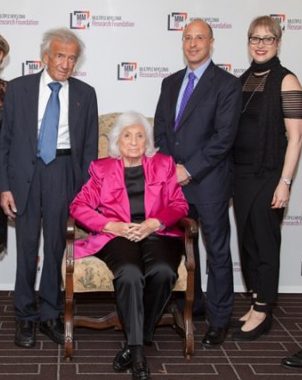
Wiesel family attends a fund-raising event for Multiple Myeloma cancer in Oct. 2015. Left to right: Elie Wiesel, wife Marion Wiesel (seated), son Elisha Wiesel, daughter-in-law Lynn Bartner-Wiesel. (Hit Ctrl and + key several times to enlarge image)
The Wiesel obituary published at Legacy.com, affiliated with funeral homes and newspapers across America, states in it’s first sentence:
Elie Wiesel, the Nobel Peace Prize-winning author who told the story of his Holocaust internment in his autobiographical novel “Night,” died July 2, 2016.
It also said: “Wiesel called ‘Night’ his ‘deposition,’ noting that it was a true story, though parts of it were fictionalized.”
So is this the final word from Mr. Wiesel on his legacy? When do we know which of the varying statements put out by Wiesel and his surrogates is the official one?
When I was checking the conflicting personal information about survivor Paul Argiewicz for my first article about Paul, I found his obituary at Legacy.com to be the most accurate in giving the true facts. Paul was a man who continually told lies and changed his story, particularly when it came to his age at the time certain key events occurred. So I think that is relevant to determining the truth of another survivor (Wiesel) who also has a record of changing details of his story. Wiesel and his wife Marion even re-translated Night for a new 2006 edition, in order to change quite a number of elements in his story that were not consistent with other elements, or with the officially accepted narrative as it’s come to be.
This obituary was probably written by a close family friend or retainer – Jewish, of course – and approved by the family. I believe it is considered a grave sin in Hasidic Judaism to lie about your ancestors, especially your father and mother, which is why it’s necessary for your published obituary to be truthful. But also, when in the state of grief for your loved one’s passing, most people want to write accurately about them and not indulge in lies and fabrications that might have seemed acceptable at other times. It’s interesting, in light of this, to see how these “facts” have been handled here.
The obit tells us that the events that followed Wiesel’s arrival at Auschwitz-Birkenau are “well known to the public” because “Wiesel dramatized them in “Night.” To dramatize doesn’t mean to make a careful record of just what one remembers, but to adapt a story so as to express it more emotionally, or strikingly, or in an exaggerated way for literary purposes. It’s also true that Night was edited so much, it was as much the product of Francois Mauriac and Jérôme Lindon, his editor, as it was of Elie Wiesel.
It is almost always said that after the family arrived at Birkenau, Wiesel’s mother Sarah and ten-year old sister Tziporah were sent in a different direction than his two older sisters – in fact, specifically to a “gas chamber” where they were immediately murdered. But here we are told that “Wiesel and his father were separated from his mother and three sisters.” Period. Nothing more. It eventually goes on to say: “He was reunited with two of his sisters after the war, but he never saw his third sister or his mother again – they died in their own concentration camp.” They could not bring themselves to repeat the invention that the two died at Auschwitz, for which there is no evidence whatsoever, so they are left with just saying they died somewhere, somehow because they were not seen again.
I have been pressing these points for a long time, but the complicit mainstream media and holocaust hacks irresponsibly repeat the false account that Elie’s mother and sister were sent immediately to a (non-existent) homicidal gas chamber at Birkenau for “extermination.”
The obit, however, does not clarify the very confusing story concerning the writing in Yiddish of the precursor to Night.
“Night” offered a stark portrayal of genocide. Amazingly, the deeply unsettling narrative was heavily edited, reduced from Wiesel’s original 862-page manuscript to a taut, terrifying 245 pages, published in 1958 in France and translated into English for U.S. readers in 1960.
This is misleading, in that the 862 pages and the 245 pages were both in Yiddish. When the 245 pages were translated into French, it became a small book of 178 pages. The English translation was only 116 pages. Wiesel wrote about 50 more books after that and all were short (except for his official autobiography, but it is made up of individual snippets of ‘memory’). So it’s a little hard to imagine that the original manuscript was his, especially since he said he wrote the entire thing from scratch during a ship’s passage between Israel and Sao Paulo, Brazil. Of course, no one has ever seen the alleged 862 page manuscript to even verify its existence. See “The Truth about Night; Why it’s not Elie Wiesel’s Story”
Saturday, October 1st, 2016
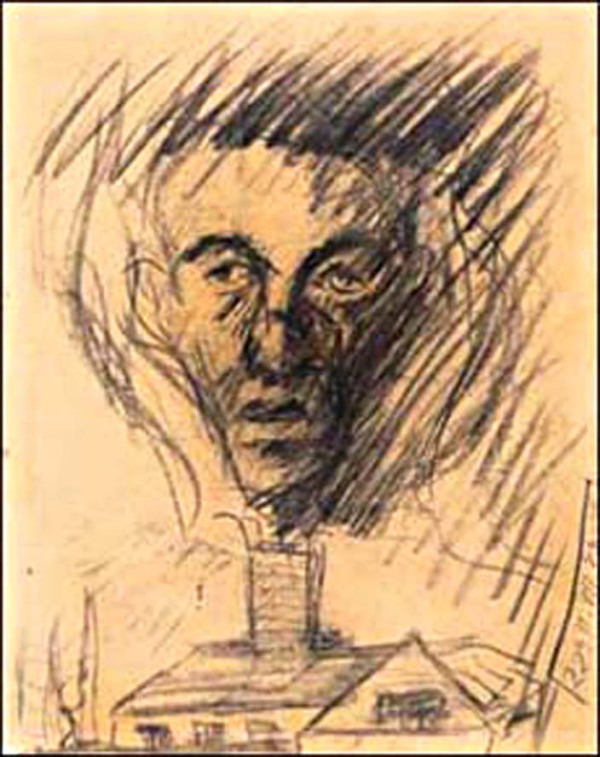
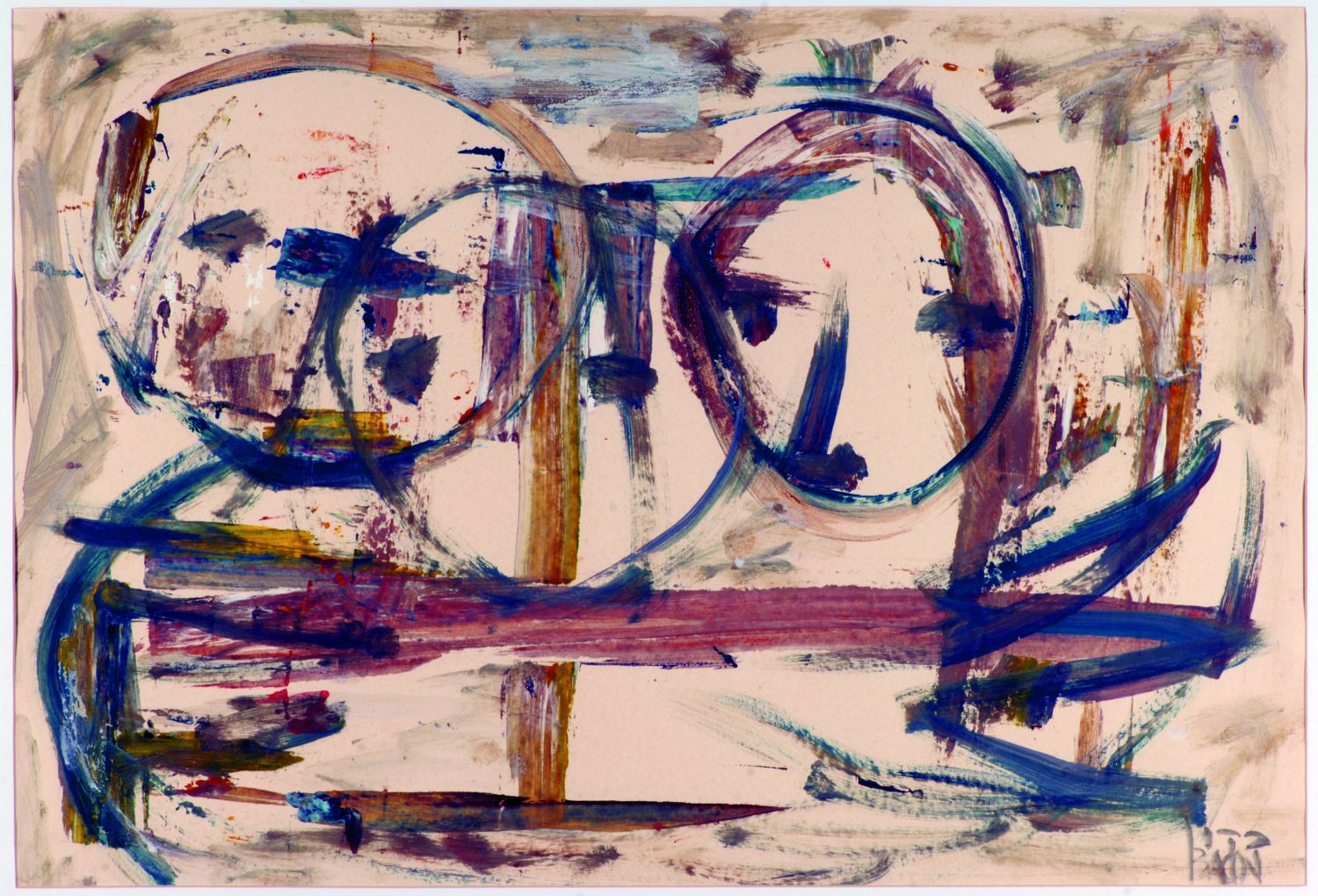
Yehuda Bacon says he drew this ‘portrait’ of his father going up in smoke at Auschwitz when he was 16 years old. He became an artist and teacher, known for his fantastical holocaust images.
By Carolyn Yeager
Bild, Germany’s most popular tabloid, has reported on a new memoir by yet another holocaust surlievor, the “world-famous” artist Yehuda Bacon (not be be confused with Yehuda Bauer of Yad Vashem). Yes, Bacon is the surname of this Orthodox Jewish man, apparently honestly come by in case you’re thinking it’s a bad joke.
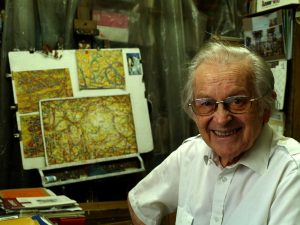
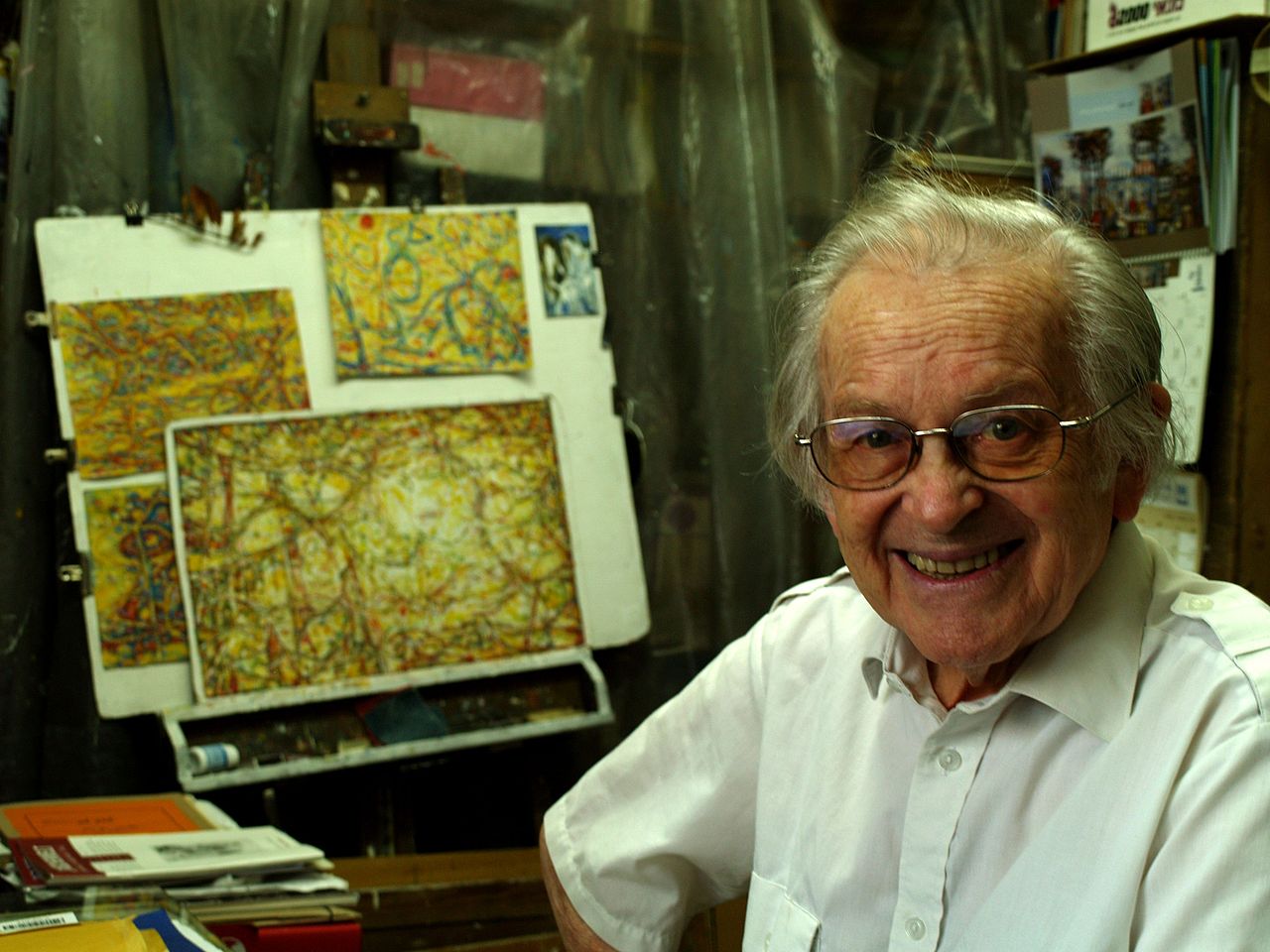
The elderly Yehuda Bacon in his studio in Jerusalem in August 2008 with some of his “world famous art” inspired by the Holocaust.
Bild informs us the memoir is comprised of a series of conversations between psychologist and author Dr. Manfred Lütz and the subject. That means Bacon is not capable of writing it himself. A part was previewed in Bild, and that inspired a hack writer to produce the sensationalized article that appeared in the Daily Mail Online. The Daily Mail is a British tabloid, pretty much the equivalent of Bild in Germany. Holocaust stories are fodder for tabloids – they love and can’t get enough of them.
I’ll start with the Daily Mail – to keep you reading, because there is a lot more to this story. Their headline was “Mengele WHISTLED Mozart as he selected victims for gas chambers, reveals survivor.” Cute, huh? I’m not sure we’ve heard that one before.
It begins: “The callousness of one of Auschwitz’s most gruesome officials has been revealed by a survivor … who was only 15 when he watched his father be taken off to be killed.”
“Mr. Bacon said: ‘He must have loved Mozart, because if he was bored during the selection he always whistled Mozart.’”
Would this 15 year-old even recognize a Mozart melody, let alone be always around when Dr. Josef Mengele was going through the alleged selection process, which supposedly took place often and in various places around the camp? In fact, we are to believe this 15 year old had such a close relationship with this Nazi that he even knew why Mengele whistled. He was bored.
I was more than skeptical of this, but I did find that Bacon may have been one of the teenagers who later dubbed themselves the “Boys of Birkenau” —orphaned boys who allegedly persuaded Dr. Mengele to add them to the “able to work” list. There will be more about this later, showing that Yehuda’s connection with Mengele may possibly have existed, but was limited.
Would he know Mengele’s moods and habits? I’m sure not. But in order to boost his bonafides, Bacon also said of Mengele: “He was always correct, he never beat us children” —slyly implying that others did, or that the doctor might have beat adults. In reality, Mengele was a very kind man whose role at Auschwitz truly was to keep the camp and the people in it free of disease. He did not make all the ‘selections’ that suvlievors attribute to him.
The Daily Mail article was short, it’s purpose only to feature the “whistling Mozart” scenario which supports the popular theme that the Nazis were superficially-cultured barbarians, and German culture is suspect. If you think people are too smart to fall for this, just read the comments following the article. A Londoner wrote: “Oh god, I whistle all the time, never again after reading this …..”
The Bild interview
Turning to the Bild article, they actually write that the 15-year-old Bacon “toiled in the crematoria of Auschwitz.” What? That’s the same thing Bild wrote about Joshua Kaufman! Nonsense, and shame on Bild (though they have no shame). There is nothing said about that in the portion of the interview Bild published. I copy only a couple excerpts.
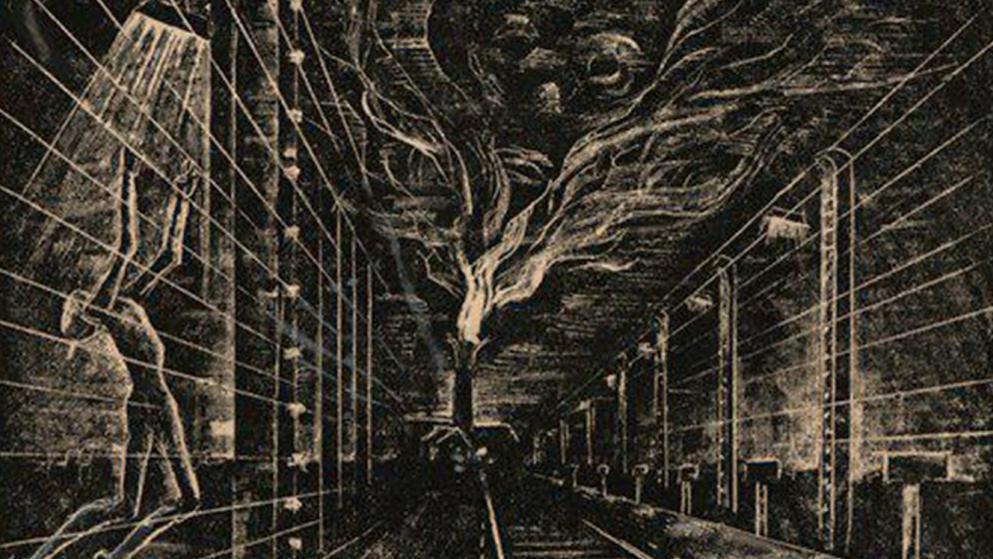
A Yehuda Bacon drawing: Flames pouring out of the crematorium chimney at night, a naked person electrocuted at the fence, and railroad tracks — all standard symbols of the Jewish Holocaust story that have no basis in fact.
Manfred Lütz: How was the end in Auschwitz?
Jehuda Bacon: On night of January 18, 1945 we had to take everyone who was left there. Some tried to hide, because it was clear: This is the end. Now the Russians are coming. We heard the guns from a distance. All had to join in … we even got a loaf of bread for the way and we waited until all were there.
[…]
Then we went out. That I still clearly remember, and exactly as we marched off, the crematoria were blown up. We could still hear these sounds and saw it too. Then we went two or three nights without a break until the Blechhammer camp.
Lütz: That was almost 100 kilometers, day and night, without sleep?
[Me: He was very right to question that. It is not possible to walk in freezing weather without sleep for two or three (which is it? – makes a big difference under those circumstances) nights. What really happened is that they walked at night and rested/slept during the day to keep out of sight of enemy planes.]
Bacon: Day and night without sleep. This is very hard. If you do not eat, if you do not sleep, when it’s so cold, if there is a lot of snow, then one becomes weaker with time. And that is a fight for survival. It’s hard to describe such a fight. But you can, if you have to.
[No, you can’t, for he then describes all those who “were shot because they couldn’t keep going.” In any case, Dr. Lütz lets it pass. Bacon also tells a story of the stereoptype ‘inhuman’ SS officer, similar to what many others have told, including Richard Stashevsky.]
Bacon: Yes. Mauthausen was actually an entirely different stock, it was originally intended for political prisoners. But now it was already half messy here. The remains of Auschwitz came to Mauthausen, but also Hungarian Jews, even from a good background, women with fur coats and all.
I saw the Hungarians who arrived and were still dressed beautifully with rings that had not yet been taken. They gave a ring for a glass of water, so thirsty were they.
And a picture that I cannot forget: There was a trolley on which containers were transported (vessels in which one normally collected waste), and it was a soup, really just water with maybe two potatoes. And now this trolley drives along and it shakes a bit, so this water-soup spills out and the drops flow together with all the dirt in the corner of the trolley. And so a prisoner comes with a small vessel and succeeds in collecting these few drops.
And since an SS man sees it and thinks it is stealing, he takes him and shoots him before a pit.
[Details? Are there any witnesses? Is anyone named? Never. This fictitious event takes place in a vacuum and is therefore a defamation against the SS.]
Bacon also claims the bread was poisoned by the SS, but for what reason I could never figure out. This is the quality of Yehuda Bacon’s “memoir.” Who is this man, Yehuda Bacon?
Yehuda ‘s biography
Yehuda Bacon personifies the show-biz and easy life of holocaust survivorship, living as a “highly praised artist” even though he has no talent and his paintings and drawings are devoid of any artistic merit. Because he was “in the camps” in his youth, he has been able to tell tall tales about what he saw and experienced there, drawing and painting images of “horror” that occurred only in his imagination – afterwards.
Yehuda was born into a Hasidic (Orthodox) family living in the city of Ostrava (Czechoslovakia) in July 1929 – making him 10 months younger than Elie Wiesel, also born into a Hasidic family. Bacon is now 87. Though he has been well-known since 1945, details about his family are missing. His parents are never named, only his sister is given a name—Hanna. Was their surname really Bacon? That isn’t a Czech or Jewish name; it’s actually, as far as I can discover, Germanic-Norman-English, so one wonders what the family name really was and how he came to use Bacon.
His family was sent to the Ghetto Theresienstadt in the fall of 1942 when Yehuda was 13 years old. It was a town southeast of Brno in Moravia that the Germans turned into an experimental “model Jewish settlement” for educated and accomplished Jews. Because of the pleasant living conditions and many cultural activities, holocaust propagandists have invented terrible things that purportedly went on there. A film titled “Terezin: A Documentary Film of the Jewish Resettlement” (translated) was made by the National Socialists showing a comfortable existence within a thriving cultural centre, but most of the film was destroyed after the war. What does that tell you?
Bacon remembers participating in a children’s opera. But in December 1943, the family was moved to Auschwitz-Birkeau, to a family camp. Six months later, according to Yehuda, he was separated from his father, mother and sister. He claims his father was simply taken away one day to the gas chamber, and about the same time his mother and sister were deported to Stutthof camp, east of Danzig, while he remained at Auschwitz. This doesn’t make much sense. But I found what really happened by discovering this newsletter about “Birkenau Boys.”
In early July 1944 there was made a decision about a selection in the camp, which in fact meant liquidation of the family camp. Only 3,500 of the present men and women were then recognized as able-to-work and left that place of death. The rest of the prisoners – old, ill and mothers with children – were to face gas chambers [more of the myth].
[…]
Among them were dozens of boys around 14 and 15 years of age. Then one of them found the courage and asked the camp “doctor” Mengele to choose individuals able to work also [from] among them. Surprisingly, he agreed, and had a crowd of teen prisoners march again. Out of them, he compiled a group of about 90 boys which he then moved to the nearby men’s camp, marked B II d. …
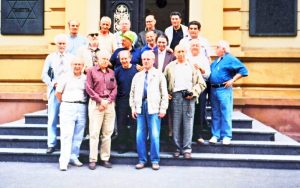
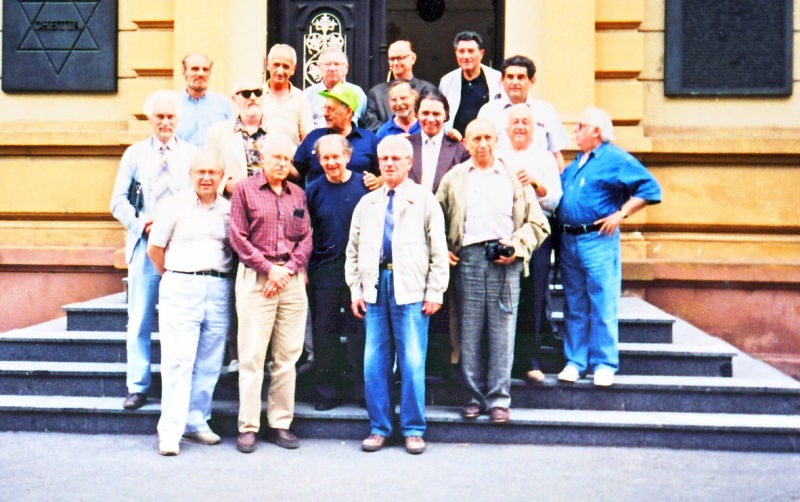
Some of the “Birkenau Boys” gather for a reunion in Terezin – the former Theresienstadt ghetto. Is that Yehuda Bacon in the middle front?
The boys were placed in the men’s camp in Block 13, known as a criminal block. The prisoners there – Poles, Germans, Russians – were under a tightened regime and got harder work. Czech boys drew attention there, however the block supervisor did not limit their activities much; they played football or sang together Czech songs. […] Their days were mostly filled up with work – they helped in the kitchen, brought from outside [the camp?] things needed to repair roads or heat houses. Some of them even worked outside the camp.
After a few weeks a selected group of “able” boys was sent to work in the Reich.
But not Yehuda – he remained until the evacuation. He was probably small and slight, and maybe in some other ways not fit. His father, mother and sister, being capable of work, were sent to other camps to work in the vital munitions factories. On Bacon’s Wikipedia page, it says he “saw his father murdered in the gas chambers.” This, of course, is the type of big, fat lie he’s always told.
The story of his liberation
Bacon claims the “death march” he was on from Auschwitz began on January 18, 1945. All it amounted to was a 2-day walk to Blechhammer, then several days of rest, and he boarded a boxcar train to Mauthausen, where he obviously was not killed. In spite of the fact that he appears to have been useless, he continued to be fed and housed by the Nazis. In early April, he was moved to Gunskirchen, a sub-camp 50 kilometers away. It was there he says he and another boy just walked away one day and met up with the US Army on May 5th. He was taken to a hospital in the town of Steyr, after which he went to Prague but could not find his family members. From there he went to France (perhaps to the Jewish Orphans Home where Elie was?) and then Israel, where he studied painting, drawing and graphics and eventually became a professor in Jerusalem. A miracle for sure, since he cannot draw. His paintings are said to “translate the Holocaust artistically” and today “hang in the Yad Vashem and the US Congress.”
The “art” of Yehuda Bacon
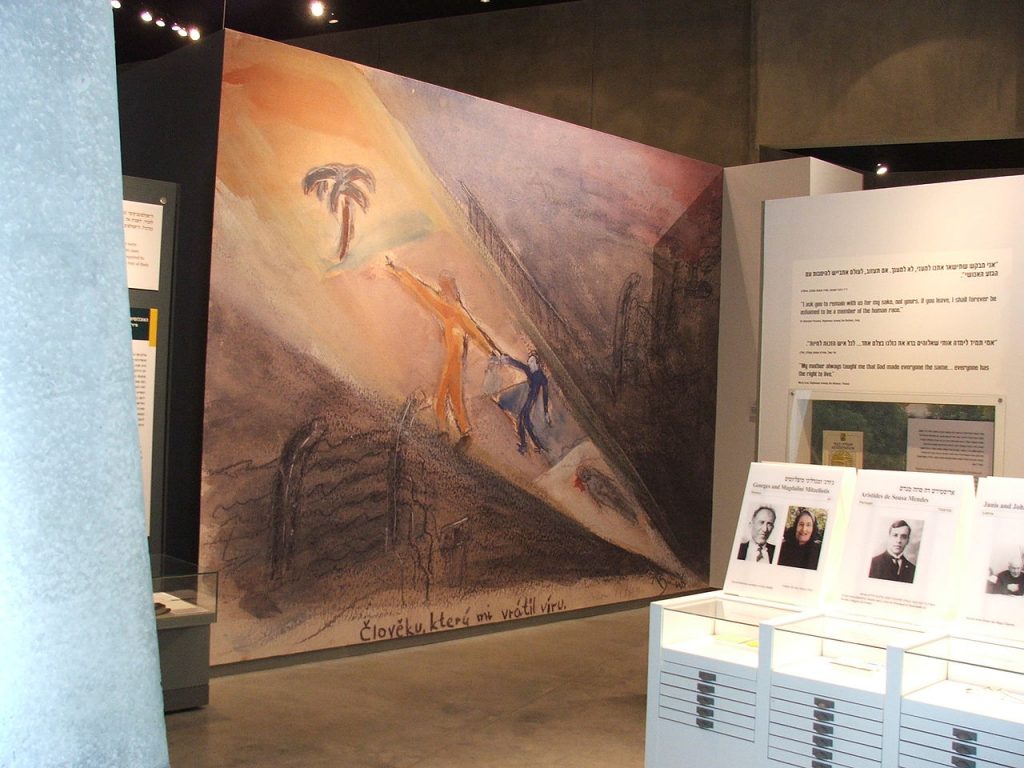
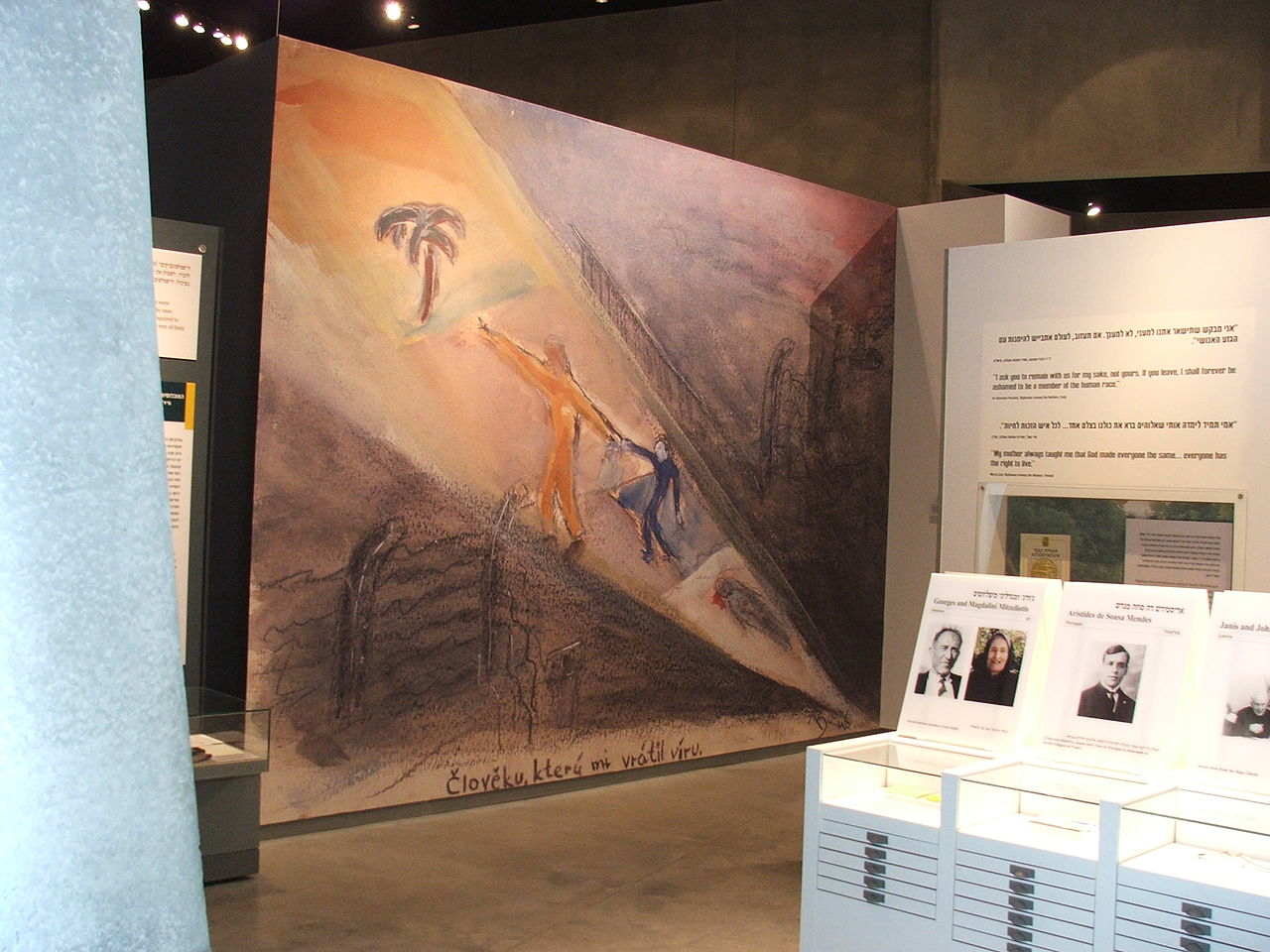
The mystical, magical, miraculous nature of surlievor tales is epitomized in this greatly enlarged reproduction of a much smaller Bacon painting installed in the Yad Vashem museum in Jerusalem. The primitive style is that of a self-taught amateur.
To cover for his lack of any talent for his chosen profession, things like this are written about his work.
His Œuvre consists of a synergistic interaction: on the one hand, Bacon processes the experiences of his childhood and youth in the concentration camps, on the other he is searching for a way of understanding through his art.
Such is the way Jewish critics cover for bad Jewish art, but Bacon is particularly only a holocaust promoter, creating primitive and ridiculous depictions of fantasy. Most of his ‘works’ are very small, too; measured in centimeters. Of special interest, he is the one who drew the “gas chamber” interior that I reproduced in my book Auschwitz: The Underground Guided Tour. These meaningless lines cannot be from memory, but he was told what it was supposed to contain. What a fraud.
You can see more of Bacon’s Œuvre here. (Sorry it’s been taken down.) His Facebook page is here.
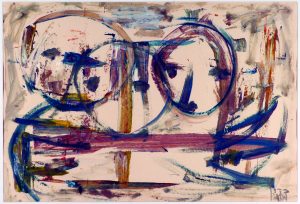
Typical Jewish art by Yehuda Bacon.
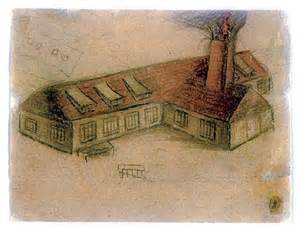
Tiny, crude drawing of a crematorium/’gas chamber’ with fire-belching chimney by Yehuda Bacon. -Yad Vashem collection
7 Comments
Category Featured | Tags: Tags: "Holocaust survivors", Auschwitz-Birkenau, Yad Vashem, Yehuda Bacon,
Social Networks: Facebook, Twitter, Google Bookmarks, del.icio.us, StumbleUpon, Digg, Reddit, Posterous.
Monday, September 26th, 2016
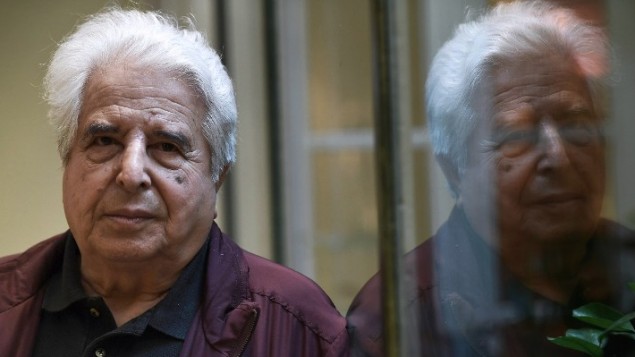
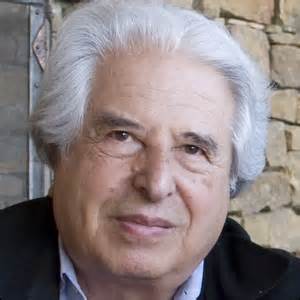
Israeli writer (but with U.S. citizenship) Saul Friedlander poses in a hotel in Paris, on September 22, 2016, the day of this interview. (AFP/Christophe Archambault)
By Carolyn Yeager
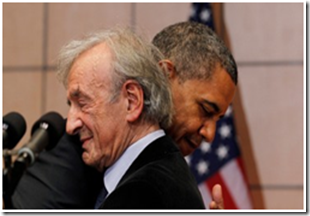
It’s very possible that Wiesel would have gone that far, even though Trump is deferential to Israel. Wiesel would have been on the side of his friend, Barack Obama (image right), and therefore supported Hillary Clinton. Just how sharply 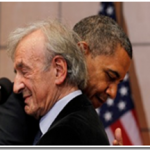 he would have addressed Trump is something we can now only imagine. But we might get an idea from the growing number of ‘progressive’ American celebrities who are proclaiming their distaste at the possibility of a Donald Trump presidency and their promise to abandon their country if their worst nightmare should come true. A significant portion of those celebrities are Jews, even in the face of his enthusiastic support for Israel and his close connections to Jews.
Among this group, Holocaust historian Saul Friedlander is the latest high-profile Jew to threaten to leave the United States if Donald Trump becomes president. Born in Prague, he now lives in Los Angeles with comfortable dual US/Israel citizenship. That means he can vote in the American election, but he will definitely not be voting for Trump. In a recent interview in Paris, Friedlander told AFP:
“One cannot exclude Donald Trump from winning, even though he is a dangerous crazy. He says whatever comes into his mind. We don’t know what he thinks.”
Translated: He doesn’t follow the Kosher script. He thinks and acts as an independent person, and in the interests of the American nation and people. The politicians Jewry supports are Israel-firsters who can be counted on to defend Jewish interests over the interests of White Americans.
“At the same time, there is a huge swathe of Americans, mostly poor, angry whites, who dream of having him in the White House. He is kind of a release valve for their anger against the ‘establishment’ represented by Barack Obama and Hillary Clinton. Because she has, unfortunately, a tendency to lie and to hide things. Trump, by comparison, seems totally open and frank, even if he has not published his income tax returns.
Translated: What the ‘huge swathe of mostly White Americans’ want is not good for Jews, so we prefer the lies and cover-up of Clinton to the open and frank Trump. After all, Jews’ first obligation is to look after themselves. In this connection, Friedlander then warned of the rise of anti-Semitism and of Holocaust denial.
“Negationists are, in general, anti-Semites, and I am utterly opposed to debating with them.”
He, Deborah Lipstadt and Elie Wiesel have all said this. Because they can’t win.
“It gets you nowhere, they will always find a so-called detail showing that all these stories of gas chambers were a joke.”
Indeed! Those troublesome, nit-picking details that reveal the gas chambers are a joke. What an admission! He said it.
“They are obsessed by the idea that Jews could have invented the story of their extermination.”
That’s a big worry. That their invention of the story of the six million will become known to the masses. Its getting closer to happening.
So it couldn’t be more clear why Friedlander fears Donald Trump. If Trump does not defend the PC in general, that could put ‘the narrative’ at risk. He might say anything! Trump is not anti-Semitic himself, but he’s not a house-trained politician that can be trusted to toe-the-Jewish-line in every instance. He may leave it up to the Jews themselves to defend it, rather than keeping it a state priority. I can understand some Jews considering moving to where they feel more assured their special benefits and privileges will be fully maintained. Germany perhaps? Many are saying Canada, so they can more easily return if Trump bombs out in four years.
Trump has said he only wants immigrants here who love the people of this nation. Since Friedlander, the immigrant, looks down on “a wide swathe of poor, angry whites” who are “angry at the establishment” (the establishment that protects and coddles him), he certainly does not love average Americans, and may even fear them. If he perceives himself as out of step with the majority of Trump supporters, this would certainly add to his feeling of discomfort with a Trump victory.
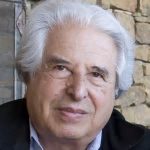 Who is Saul Friedlander?
Friedlander, 83, was born in 1932 in Prague, grew up in France where he was sheltered in a Catholic boarding school from 1942 on, and immigrated to Israel in 1948. He served in the Israeli army. From 1953-55, he studied political science in Paris (should have run into Elie Wiesel at that time) and became very active in the World Zionist Organization and the World Jewish Congress. By 1959 he had become an assistant to Shimon Peres, Israel’s Defense Minister, and in 1963 he was granted a PhD from the Graduate Institute of International Studies in Geneva, where he remained teaching until he moved to UCLA in 1988 as a professor of history (Club Chair in Holocaust Studies).
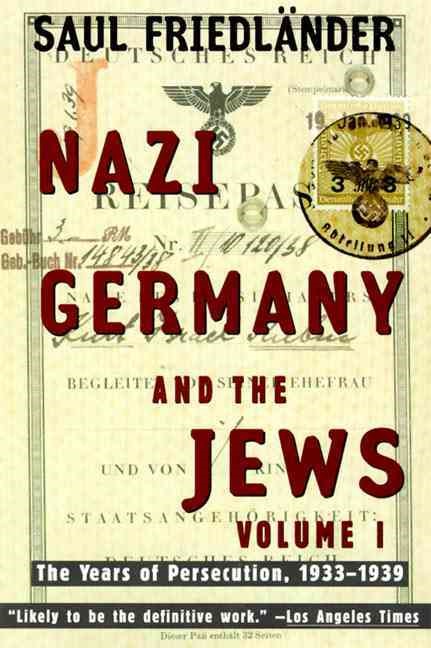
Friedlander’s magnum opus came out in 1997 titled Nazi Germany and the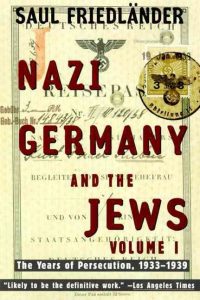 Jews. The second volume, The Years of Extermination: Nazi Germany and the Jews, 1939-1945 appeared in 2007. Friedlander is known as an Intentionalist, although he only goes back to 1941 when Hitler decided to “exterminate the Jewish people” – not earlier as some Intentionalists do (like to the writing of Mein Kampf). He also takes the position that the Jews had no idea what was happening to them and that is why they went to their deaths like ‘lambs to the slaughter’. “They simply didn’t know what was happening,” he argues. Friedlander never lived in Nazi Germany; he was a child in France during the war. So he’s simply a historian, poring over documents and reading witness accounts, second hand.
Friedlander says that his parents were gassed at Auschwitz, and that he learned about it in 1946. Since there were no gassings and no records of gassings at Auschwitz – how did he find out about it? He himself revealed that an unnamed Jew (a family friend) wrote to Friedlander’s grandmother informing her that his parents had been sent to Germany or to a Jewish reservation in Poland. That’s it. That’s the proof.
If you watch Friedlander on one of the many videos where he is being interviewed, he comes across as an utter bore who speaks excruciatingly slowly. At least for me he does; I can hardly bear waiting for his next word to come. He is feminine in appearance, in contrast to Donald Trump who is distinctly masculine.
Friedlander had a famous debate with a German historian Martin Broszat. Friedlander argued that the study of the Nazi period was ‘global’, that it belongs to everyone, and it was a problem when some German historians wanted to focus on everyday life during the Third Reich. A big part of the discussion was whether the National-Socialist period could be treated as another period of German history – as in, from the Imperial to the Weimar to the National-Socialist to the present day. This was relevant, for instance, in the growth of the welfare state – since the Third Reich did extend welfare programs for its citizens in a responsible and historically fitting way.
Friedlander was totally opposed to any such suggestion. His arguments against it are weak – in fact they are frivolous. For example, he argued his first “dilemma” with it was that such an approach would cause historians to lose their attention to the genocidal politics of the Nazi state. His second major objection was that by looking at the Nazi period as “normal”, there was a danger that historians might lose interest in the ‘criminality’ of the Nazi era. Third, he said if the Nazi era was ‘historicized’, it might allow historians to advance apologetic arguments about National Socialism, as he said Ernst Nolte and Andreas Hillgruber had already done. Well, we can’t have that, can we? – says the Jewish apologist Friedlander.
Actually, all three of his “dilemmas,” as he called them, seem to be the same one. It takes away from his reputation as a great thinker, doesn’t it? Friedlander is actually a mediocre talent who got ahead with the help of Jewish connections.
Friedlander and Elie Wiesel
Saul Friedlander and Elie Wiesel were friends, born four years apart and their views on Germany and the Holocaust are very close. They both see the “Holocaust” as an event unique in history, impossible to discuss in normal language, and the result of anti-Semitism. Friedlander believes that ‘Nazi anti-Semitism’ is a distinct form of it that could bring about redemption for the anti-Semite. So Friedlander is a bit of a mystic too.
In his autobiography All Rivers Run to the Sea (p. 329), Wiesel tells a story about Friedlander. He said he saw Saul in 1958 or 1959 in Manhattan when Saul was working for Nahum Goldman and the World Jewish Congress. Saul was depressed and taking Valium because no publisher was interested in his writing about Pope Pius XII and Nazi Germany. Wiesel said he introduced him to publisher Paul Flamand and that was the turning point in Saul’s career. Is Flamand Jewish? I can’t say absolutely yes, but I’m pretty sure he is. Wiesel wouldn’t turn to anyone but a Jew.
Friedlander maintains that the essence of National Socialism is that it “tried to determine who should and should not inhabit the world.” Further, it resisted any attempt to integrate it as part of the “normal” development of the modern world. But who is to say what the “normal” development of the world is? Clearly there is a difference of opinion there. But Jews insist there is only one way – their way. So again, the one who insists on how the world should be is the Jew.
Elie Wiesel has already departed this world. If Saul departs from the United States of America, and potentially revokes his citizenship (although he probably wouldn’t have the guts to do it), all the better for the United States. Barbra Streisand too, and Jon Stewart, Barry Diller, oh, there is a whole list of them. How we poor, angry Whites will celebrate their leaving. The media will describe it as a blow to our nation, but we Whites know better.
Friday, July 15th, 2016
Enlarged close-up of Elie Wiesel’s arms in a 2006 photograph by Eyal Toueg, first published in Haaretz (see previous article).
by Carolyn Yeager
copyright 2016 Carolyn Yeager
It’s pretty pathetic to be confronted with a picture like the above, and expected to acknowledge that it is Elie Wiesel’s Auschwitz tattoo that I have been asking to see for six years now. Once again, the best suggestion I have for magnifying it is to click on it to get the image page, then hit the plus key up to 8 times while holding down the Ctrl key. The image stays sharp while being greatly enlarged. What do you see? I invite all the amateur, and maybe professional sleuths out there to do their thing.
Wiesel has been hiding this faded-out, so-far-undecipherable spot on his arm for 70 years, and now that he’s safely buried and completely inaccessible, Haaretz, the Israeli newspaper that broke the story of Wiesel’s death, is beginning to reveal that arm. At least, that’s how it looks from where I’m sitting.
To the naked eye, it appears to be a bruise on the arm. Upon magnification, we can barely make out what appear to be numbers, but it’s not at all clear what numbers they are. I think I see a couple but I’m not going to reveal what they are because I want a better image – and think we all deserve one. The dark and light lines made by his arm hair create a confused mess, visually. What we need are more high-resolution photographs like this one, preferably with a straight-on view of the arm. The photographer Eyal Toueg must have taken many shots on this day in 2006 and he would have all the negatives. It is his responsibility to publish them all, every one that shows Wiesel’s left arm, but he is probably Israeli and is under the dictate of higher ups. Someone else may have bought all the negatives. Maybe Haaretz owns them.
As it is, we are left with many questions – such as, why has Wiesel refused to show his supposed faded tattoo over the years? Is it because it’s unreadable? If he revealed it, the public would question it – or at least sceptics would – and he was not prepared to answer questions. Probably, if there were journalists who took a genuine unflinching investigative approach, he would have been forced to discuss it, but none did. The efforts of Jean Robin of Enquete & Debat website to encourage such an investigation show conclusively that lack of journalistic willingness.
Has it been kept hidden because it is not A-7713? Could that be why whatever was there has been defaced or somehow unnaturally/synthetically faded or smeared? I cannot find any example of an Auschwitz tattoo that looks like his does.
Is it because it is something he put on his arm himself when he was a youth in France? In this 1945 b&w photograph (below) taken at the French orphanage for Jewish boys we see what looks like an Auschwitz tattoo, albeit a tiny one, on Wiesel’s arm in the same place we see the dark spot in the 2006 photo.
Elie Wiesel in summer 1945 in France – 16 going on 17 years of age.
The ready conclusion is that it’s his Auschwitz tattoo A-7713. But we can’t make it out at all! It’s already faint in 1945 and when I magnify it, no part of it is recognizable.
It’s also interesting that this photograph was posted on the Internet by French Jew Loupi Smith, but it doesn’t seem to be in the US Holocaust Memorial Museum online collection (where it is hopeless to try to view their Wiesel photo collection, anyway; they obviously don’t want you to see it). Nor is it in the Yad Vashem photo collection under Elie Wiesel – in fact, they have only 3 photographs with Wiesel in them – all the rest are aerial views of Auschwitz-Birkenau! Really weird. I think this decision to withhold pictures of Wiesel can only have come from Wiesel himself. In my opinion, though, the above is definitely a photo of Elie Wiesel in 1945 in France.
Our next pictures are these two, which show the same mark on the arm in the same place, but both are still completely unreadable as numbers. I assume these pics are from the same 2006 photo shoot that produced our newest picture, which is a much better high-resolution image. We can see sharp detail, but the “tattoo” is still not decipherable. It’s a really bad “tattoo!” The problem does seem to be with the “tattoo,” not the photograph. It is just very faint.
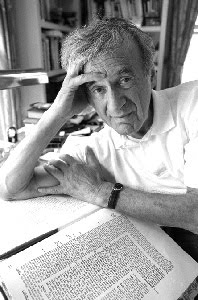
When this 2006 image is magnified, the possible “tattoo” is seen only as a darker spot, not recognizable as a number.
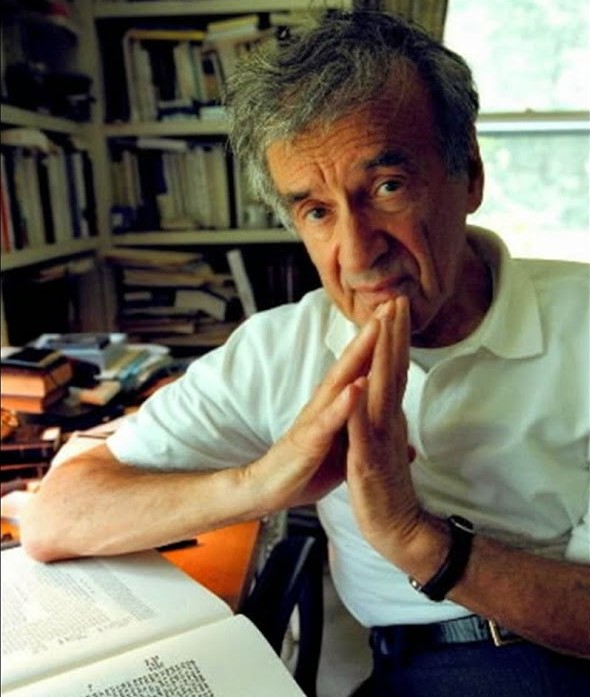
This image was also uploaded by Loupi Smith, but where did he get it? It’s obviously from the same 2006 photo shoot by Eyal Toueg.
Now take a look at another man’s equally hairy arm below– he is Erwin Farkas who was transported to Auschwitz from Hungary in 1944 at the age of 14. His number, A-7899, is only 186 digits beyond A-7713 – they are in the same time frame. His tattoo is faded and a little blurred, but still legible. There is no discoloration of the surrounding skin and the numbers are definitely blue. In fact, all the tattoos that one sees on the Internet are in this good of shape or better (many are fake though).
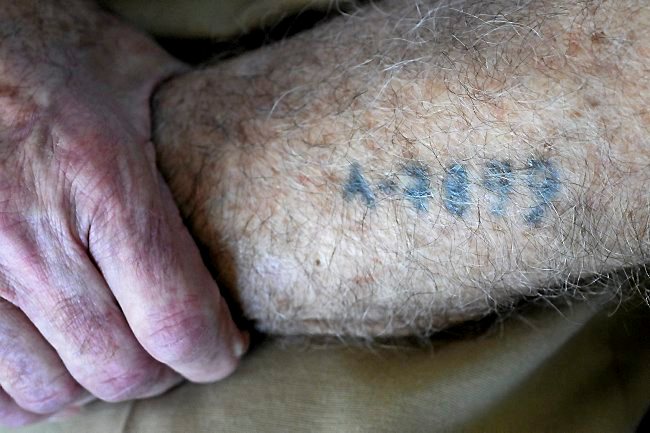
Erwin Farkas displays the Auschwitz tattoo A-7899 on his arm.
What happened to Wiesel’s that it is almost impossible to see? Only Wiesel could answer that – or would – so it’s clear that he didn’t want to since he didn’t allow the higher quality picture at the top of this page be published during his lifetime.
In the “court of public opinion” and morally (if not legally), there is no excuse for Elie Wiesel to have been given the velvet-glove treatment he was by journalists and by historians. He had a duty to show the tattoo he said was on his arm and allow it to be photographed. He had a moral duty to prove that it was what he said it was—A-7713. His failure to do that over the course of many years makes him, and the mainstream media that enabled him, guilty of worse than negligence — they are guilty of withholding evidence. The media and academics are more guilty than Wiesel himself because Wiesel has to be given the right not to incriminate himself.
But morally, Wiesel is guilty of withholding evidence that was available all the time.
Above, I used the words “higher quality” but if all these pictures of Wiesel in the white knit short-sleeve shirt were taken on the same day by a professional photographer (which it makes sense that they were) then they should all be of similar high quality. And since we can’t make out the numbers on any of the three, it can only be that it’s the fault of the ‘tattoo,’ not the photography.
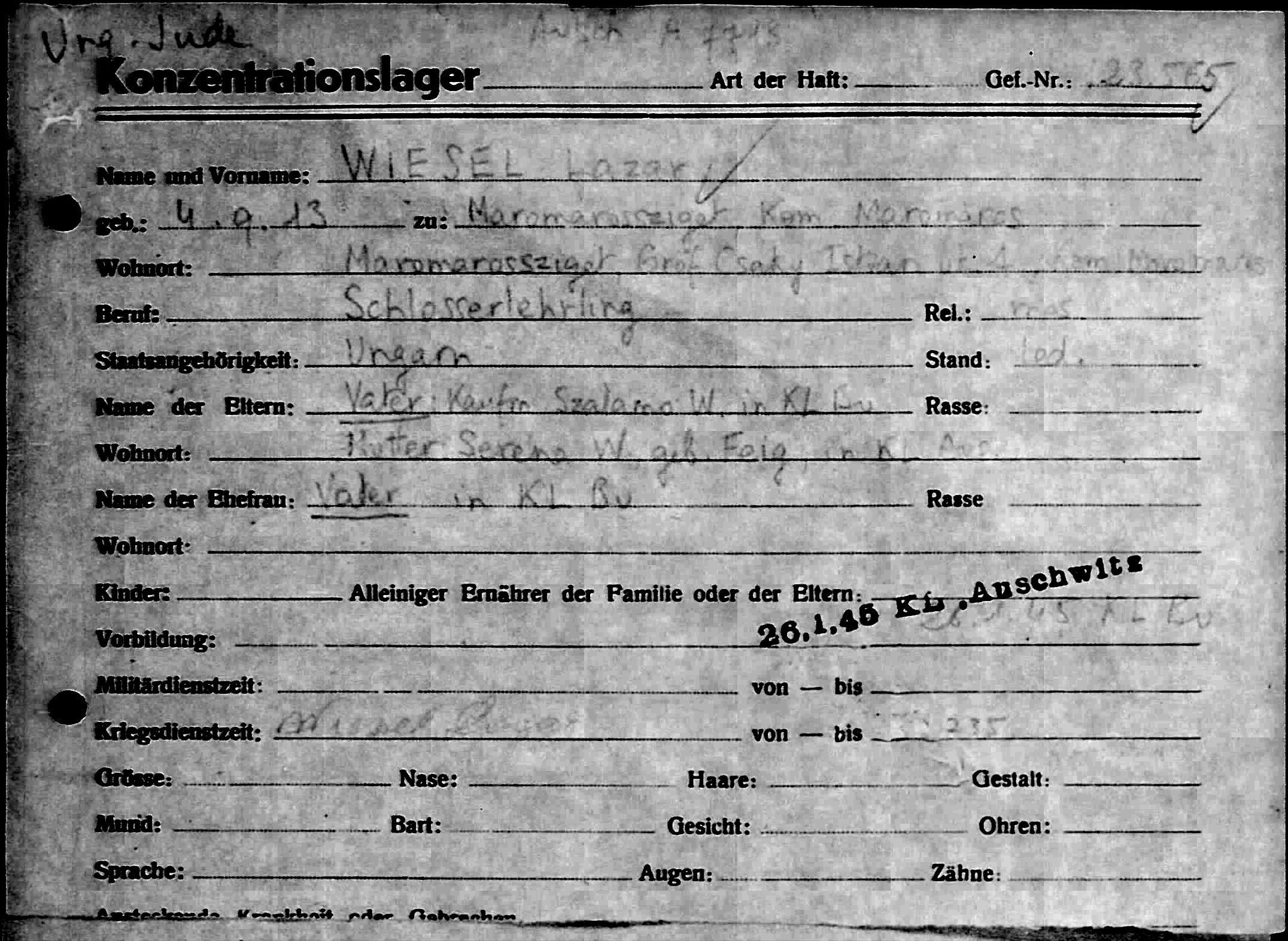
I don’t believe this latest-to-be-revealed photograph from 2006 is photo-shop in any way. I do believe this is what Wiesel has on his arm, which he always claimed was A-7713. If it turned out to be A-7713, I would’t be upset in the least because all I’ve ever wanted was the truth about Elie Wiesel. But there will be questions and I will have a very hard time reconciling myself to the idea that the SS camp authorities could have made up a registration card for a 15 year old boy with the information that he was a 31-year-old man with the occupation of Schlosserlehring (Locksmith) – and never correcting it – allowing this boy to enter Buchenwald with that identification. No, it would be very hard to believe that.
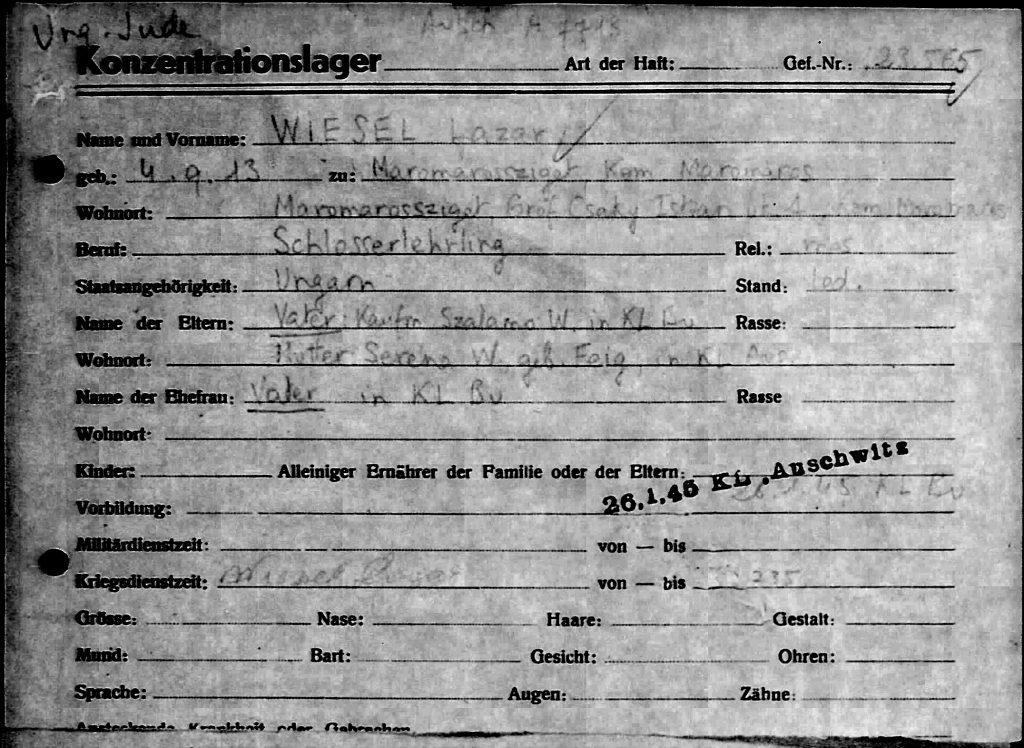
The Buchenwald file card that shows Lazar Wiesel, born Sept. 4, 1913 (age 32), occupation locksmith, A-B prisoner number A-7713, arrived in a transport that left Auschwitz on Jan. 26, 1945.
So I can only hope that more of these photos by Eyal Toueg will be published. Because as it stands now, Elie Wiesel’s tattoo claims still don’t pass the most elementary test – that of what the heck is the number!
12 Comments
Category Featured | Tags: Tags: Auschwitz tattoos, Elie Wiesel, Erwin Farkas, Lazar Wiesel,
Social Networks: Facebook, Twitter, Google Bookmarks, del.icio.us, StumbleUpon, Digg, Reddit, Posterous.
Saturday, July 9th, 2016
BY CAROLYN YEAGER
copyright Carolyn Yeager 2016
Though they say a picture is worth a thousand words, these two need some explanation. One is from 1987, the other from 2006. Since the more recent one will arouse much more attention, I better start with that.
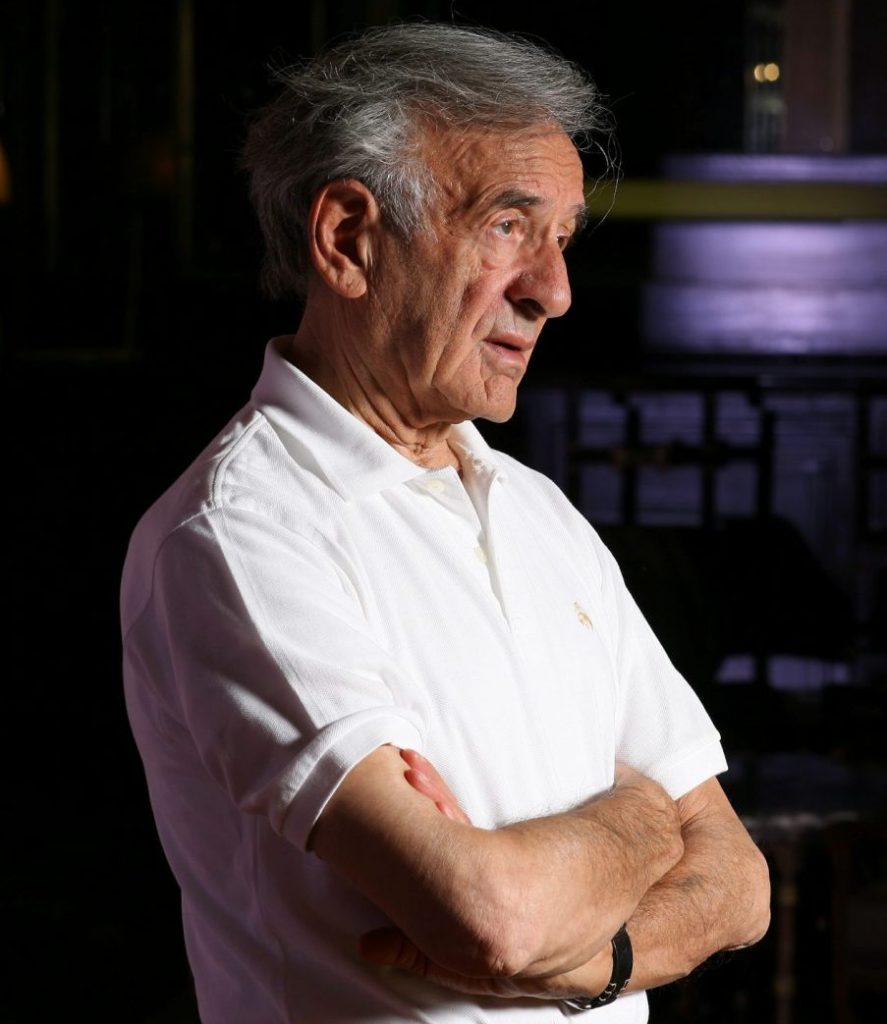
This 2006 photograph taken by Eyal Toueg, displayed in a July 9th “Premium” article by Shlomo Nakdimon at Haaretz, has been cropped by me to remove some of the dark space to the right … the better to see the important details. This may be the first time it has been published.
You will notice right away that there is a smudge on Wiesel’s left forearm, precisely where an Auschwitz tattoo would be. Many people will say, Oh, that’s his very, very faded and blurred tattoo. But it looks more like a bruise, and, by using your keyboard to enlarge the image while retaining a clear resolution, you’ll find, as I did, that it then looks even more like a bruise the larger you go. Plus there seems to be more bruise just above it where his right arm meets his left. [I’m speaking tongue-in-cheek here, and below. I don’t actually think it is a bruise, but all we can see, even highly enlarged, is a smudged blue area that looks like a bruise. So what are we to call it?]
[To enlarge the image, first click on it to get the full size image, then hold down the Ctrl key while clicking the plus (+) key as many times as you can or want. To bring it back to normal, do the same with the minus (-) key. Both keys are on the upper right next to “backspace”]
This photograph has to be from the same photo session that includes the one where he’s sitting with the oversize Hebrew book — he’s wearing the same white knit golf shirt and his hair is the same. That one has been used by Wiesel defenders to suggest there is a faint tattoo on his arm. You can see it here and here.
However, this kind of thing is the typical Wiesel mode of operation throughout his life. He refuses to be explicit about his person and his personal life, even though he gets very explicit about things like the “shades of wateriness of the soup” and the face of the boy he wrote was hanged in Auschwitz. But his own body–which can be checked–he offers not a word of description. And looking at this blue-black discoloration, I can see nothing—even with using all my imagination—that I could imagine to be a 7713. I know you can’t either, but you might try to come up with some theory about it. I have my own theory, that Wiesel pinched himself real hard the day before the photographer came.
In 2006 he was 77 years old, an age when it’s extremely easy to bruise the skin. And that’s what it looks like. Recall the tattoos of so many other inmates from his same time there — none look like this.
But I have a second theory, which might be better — that Wiesel had applied his own tattoo number with ink but he didn’t go deep enough. It was only applied to the dermis (outer layer of skin), not the epidermis, and so it disappeared over time as new skin cells grew until now it is just a smudge of dispersed ink. Remember the top photo on this page that doesn’t look like a real tattoo — this may be when he did it.
Now, the other picture indicts him even more. He is in Lyon, France for the Klaus Barbie show trial and stops by the Holocaust Memorial there on June 2, 1987. He just won the Nobel Peace Prize 6 months earlier, and this Buchenwald liberation photo was associated with him winning that prize. You recall right after the ceremony he traveled to Yad Vashem in Jerusalem and posed in front of a large blow-up of this very photograph.
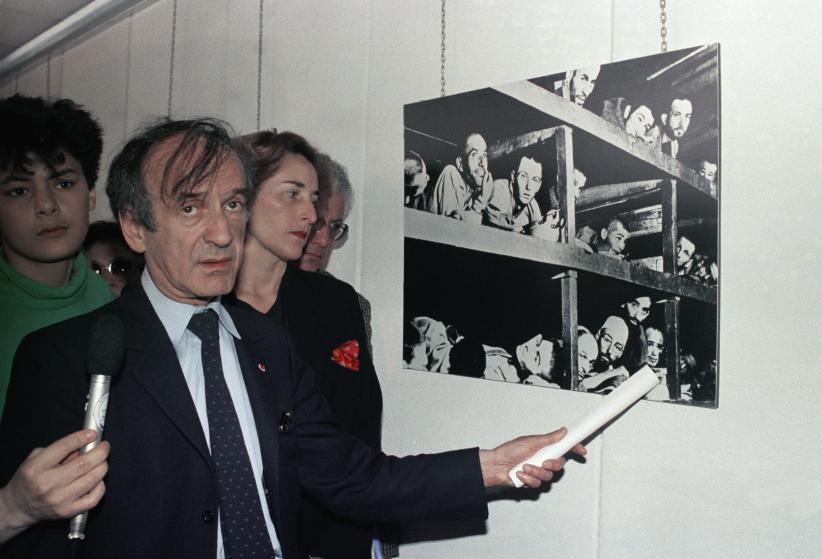
Elie Wiesel, winner of the 1986 Nobel Peace prize, visits the Holocaust Memorial in Lyon, France, June 2, 1987. The photo on the wall shows prisoners of the German Buchenwald concentration camp inside their barracks, five days after U.S troops took over the camp near Weimar, Germany. Wiesel points to himself in the picture. (AP Photo/Laurent Rebours)
Notice that Michael Grüner on the bottom row was cropped out of this version, along with the tall standing man, but there is Mel Mermelstein peeking out from the upper far right. Mel wrote a whole book about his incarceration before Wiesel said in 1983 that he was in this picture, but Mel never mentioned knowing the already famous Elie Wiesel there in his book! Mermelstein resided in the children’s barrack, too.
In this photograph, the unkempt Wiesel is sealing his doom by pointing directly to the unknown person (not him) he is claiming to be himself. And with such a guilty expression, too! Nothing could prove his dishonesty and forgery better than this.
I came upon this picture in the Time magazine Elie Wiesel photo collection posted at the time of his death. When I saw this one I quickly saved it. This might be my all-time favorite picture of the Wiesel. I will surely make more use of it.
23 Comments
Category Featured | Tags: Tags: Auschwitz tattoos, Elie Wiesel, famous Buchenwald photo,
Social Networks: Facebook, Twitter, Google Bookmarks, del.icio.us, StumbleUpon, Digg, Reddit, Posterous.